Suffolk Moth Group Newsletter
Issue 12 - August 1998
Edited by Jon Nicholls
In this issue
Editorial
The wet weather of April was followed by even more wet weather in June.
Most of the Friday nights have been dry, however, with clear skies and
the promise of large catches somewhat elusive. We have on the other
hand had many nights with numbers around the hundred mark thanks, in
the main, to the use of several traps. Even when using less powerful
lights, such as the phosphorous lights I have in two of my traps, we
are still finding different moths in them compared to the high wattage
MV bulbs. This means that the fifty or so species that we would be
getting at the sheet are soon boosted by the extra species found in the
other traps. Every year you hope to have that perfect evening when all
the conditions are just right - warm, cloudy, calm and humid - well we
are still hoping!
Willow Beauty or Mottled Beauty? -
Jon Nicholls
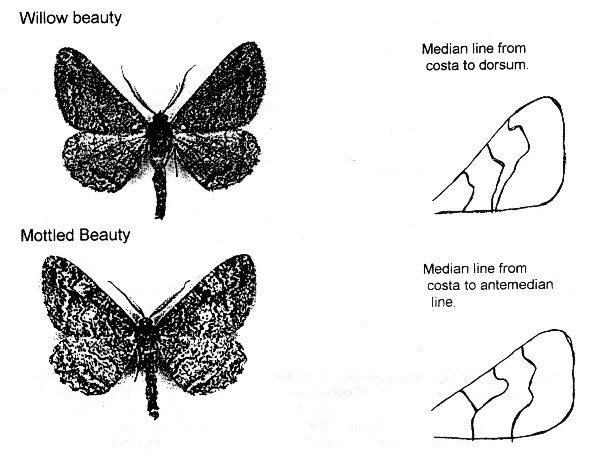
Another tricky identification problem can be between the Willow Beauty,
Peribatodes secundaria, and the Mottled Beauty, Alcis repandata. Part
of the problem is that they vary so much themselves that two adults of
the same species can look very different and the initial assumption can
be that they are from two different species. However there does seem to
be a fairly reliable way of telling most adults apart.
If you look at the Willow beauty the median line runs from the costa
through to the dorsum. Towards the dorsum it runs very close to the
postmedian line but does not touch it. In the Mottled beauty the median
line leaves the costa and then turns, towards the antemedian line,
which it joins making the outline of a square. This method can be used
reliably, as most specimens seem to show this feature in all but the
most faded state.
The Colour Identification
Guide To Caterpillars of the
British Isles. By Jim Porter. Viking Press £40.00 Book Review by
Neil Sherman
This book aims to promote an interest in the identification of
caterpillars in the same way Bernard Skinner's moth guide has in recent
years. It is set out in the same format, with the text on each species
listed in Bradley and Fletcher order, with an excellent series of
plates of the final instar larvae (including butterfly caterpillars) at
the back of the book.
The text on each species is very detailed: there is a description of
the caterpillar including its size (in mm), colour, shape, distinctive
features (e.g. clumps of hairs) and any variations in form. This is
followed by a list of the foodplants and the species habits i.e. what
time of year it occurs, where on their foodplant to find them, the
easiest method of obtaining the caterpillar (e.g. by beating or from
eggs from a trapped female), how to breed them, mentioning any special
conditions required, and also where the species occurs in the U.K.
Finally, it lists the plate numbers the photograph of the larva occurs
on, and how the caterpillar in the picture was obtained, also
mentioning the time of the year it was found.
Practically, I found this book simple to use, checking the plates of
the caterpillars for one which matched my specimen, then following up
by reading the text to see it was the correct time of year etc.
Personally, I have used it to identify Green Hairstreak butterfly,
Cream-spot Tiger and Heath Rustic moth caterpillars with ease. It also
gave me a tip of how to locate Broad-bordered Bee Hawk-moth larvae by
searching for the small round holes eaten out either side of the midrib
of Honeysuckle leaves. I have now found this evidence on four different
sites, increasing the distribution of this (under-recorded! Ed.) moth
within the county.
Its only failing is that not all the species have photographs - yet -
about nine resident and about thirty irregular migrants still require
pictures, but should be included in subsequent editions of the book. I
thoroughly recommend this book to anyone who has an interest in moths.
It will be of special use to people who beat for caterpillars, breeders
and also help the recorders find larvae of species that do not come to
light, thus completing the county moth survey. Definitely a book for
the amateur and professional lepidopterist's bookshelf!
Suffolk Moth Survey
Darsham Marshes. Friday 5 June
Darsham marshes is an excellent area for moths with a mixture of
habitats. Near the entrance is some rough ground with short grass and
bracken, this leads into an area of mixed woodland surrounded by small
water filled ditches, especially after all the rain. Then beyond that
is open marshes, fed by a dyke that feeds into the Minsmere River. We
set up in and around the wooded area with seven traps of various types
and recorded over eighty species. The moths included; Angle Shades,
Beautiful Golden Y, Bird's Wing, Buff Ermine, Buff-tip, Burnished
Brass, Chinese Character, Cinnabar, Common Wainscot, Coxcomb Prominent,
Cream-spot Tiger, Elephant Hawk-moth, Figure of Eighty, Gold Spot,
Ingrailed Clay, Large Nutmeg, Light Brocade, Lychnis, Maple Prominent,
Marbled Brown, Oak Hook-tip, Pale Oak Beauty, Pale Prominent, Peacock
Moth, Pebble Hook-tip, Pebble Prominent, Peppered, Purple Bar, Sandy
Carpet, Scorched Wing, Setaceous Hebrew Character, Shark, Small
Elephant Hawk-moth, Spectacle, Straw Dot, Swallow Prominent, Vine's
Rustic, White Ermine and Yellow Shell. Micros included; Crambus lathoniellus, Agapeta hamana, Olethreutes lacunana, Plutella xylostella, Hedya nubiferana, Hypsopygia costalis, Udea olivalis, Blastobasis decolorella, Clepsis spectrana and Parapoynx statiotata.
Sizewell Belts. Friday 12 June
Sizewell Belts has been a very successful site on previous visits with
its varied habitats. There is mixed woodland, an open field and an
extensive area of marshland. We placed traps in all three areas but
with temperatures soon down to 4 0C very quickly, were not too
optimistic. It was very slow at first but after midnight, when the
clouds came over and the temperature got up into double figures, we
finally had a reasonable total of over fifty moths including; Angle
Shades, Blood-vein, Brown Rustic, Buff Ermine, Cream-spot Tiger,
Drinker, Elephant Hawk-moth, Eyed Hawk-moth, Green Silver-lines,
Ingrailed Clay, Light Emerald, May Highflyer, Pale Oak Beauty, Peacock
Moth, Peppered, Pine Hawk-moth, Privet Hawk-moth, Straw Dot, Vines
Rustic and White Ermine. Micros included; Ghost, Plutella xylostella, Crambus culmella and Bactra lancealana.
Creeting St Mary. Friday 19 June
Alder Carr Farm is situated off the A14 near Needham Market where it
produces a large variety of vegetables and fruit. There is a small
mixed wood, surrounded by a series of ditches and a pond, on the farm.
We set up six traps and attracted over one hundred moths in all,
including; Alder Moth, Barred Yellow, Blood-vein, Broom Moth, Brown
Rustic, Buff Arches, Buff-tip, Burnished Brass, Common Footman,
Cream-bordered Green Pea, Dingy Footman, Dot Moth, Elephant Hawk-moth,
Figure of Eighty, Golden Plusia, July Highflyer, Large Nutmeg, Lime
Hawk-moth, Mullein, Peppered, Poplar Grey, Poplar Hawk-moth, Privet
Hawk-moth, Sallow Kitten, Sandy Carpet, Scorched Carpet, Scorched Wing,
Silver Y, Small Angle Shades, Small Seraphim, Spinach, Swallow
Prominent, V-pug and Yellow Shell. Micros included; Udea olivalis, Olethreutes lacunana, Eurrhypara hortulata, Agapeta hamana, Crambus perlella, Archips podana, Aphomia sociella, Eurrhypara coronata, Anthophila fabriciana, Tortrix viridana, Blastobasis lignea, Eurrhypara lancealis, Epiblema uddmanniana, Hedya dimidioalbana, Myelois cribrella, Catoptria pinella, Nymphula nymphaeata and Pandemis ceresana.
Knettishall Heath. Friday 26 June
Knettishall Heath is a country park on the northern edge of the county
near to Thetford. The scrubby heath land produced over eighty species
including; Elachista cerusella,
Pandemis cerasana, Aleimma loeflingiana, Catoptria pinella, Scoparia pyralella, Drinker,
Blotched Emerald, Royal Mantle, Small Waved Umber, Sharp-angled Carpet,
scorched Wing, Peppered, Light Emerald, Privet Hawk-moth, Elephant
Hawk-moth, Small Elephant Hawk-moth, Lobster, Iron Prominent, Rosy
Footman, Heart and Club, True Lover's Knot, Grey Arches, Clay,
White-point, Sycamore, Brown Rustic, Large Nutmeg, Rosy Marbled,
Marbled White Spot, Green Silver-lines and Spectacle.
East Bergholt. Friday 3 July
East Bergholt Place Nursery contains an arboretum, with a wide variety
of mainly non-native trees, in a large area of greenery about half a
mile from the banks of the Stour. Adjacent to the nursery is an area of
fairly old woodland with some more native plants and also a large area
of open grassland. We were joined by some members of the Essex Moth
Group who added two more traps to the seven we had with us. The
temperature was in the low teens throughout the evening and dropped to
11°C by the end of the night so our list of over one hundred
species was a sign of the potential of the site. Some of the
interesting species included; Barred Straw, Brindled White-spot, Buff
arches, Buff-tip, Campion, Clay, Clouded Magpie (the stars of the
night), Common Emerald, Cream-bordered Green Pea, Dotted Fan-foot,
Elephant Hawk-moth, Engrailed, Eyed Hawk-moth, Figure of Eighty, Flame
Shoulder, Green Pug, Green Silver-lines, Grey Arches, Ingrailed Clay,
Large Emerald, Light Arches, Maple Prominent, Miller, Mouse, Peach
Blossom, Peacock, Peppered, Pine Hawk-moth, Poplar Hawk-moth, Poplar
Lutestring, Privet Hawk-moth, Rosy Footman, Sandy Carpet, Scorched
Wing, Small Blood-vein, Swallow-tailed Moth, Varied Coronet and V-Pug.
Amongst the micros were; Udea
olivalis, Celypha striana,
Ditula angustiorana, Crambus lathoniellus, Olethreutes lacunana, Epiblema uddmanniana, Agapeta hamana, Eurrhypara coronata, Hypsopygia costalis, Catoptria pinella and Myelois cribrella.
Hintlesham/Hadleigh. Friday 10 July
The annual Hadleigh Naturalists Society moth night was held in a
private house garden on the Hadleigh to Hintlesham road near a noisy
factory making large containers, which seemed to be working all night,
with their competing lights, in an otherwise typical mid-Suffolk
agricultural setting. The garden had a large area of long grass and
some old fruit trees but no other mature tree. With temperatures around
fifteen degrees and high humidity we saw about eighty species
including; Blood-vein, Brimstone, Broad-barred White, Buff Arches,
Clay, Coxcomb Prominent, Dark Sword-grass, Elephant Hawk-moth, Green
Pug, Light arches, Lunar-spotted Pinion, Lychnis, Maple Prominent,
Orange Moth, Peach Blossom, Peppered, Ruby Tiger, Small Rivulet and
Spectacle. The micros included; Olethreutes
lacunana, Homoeosoma sinuella,
Crambus perlella, Eucosma cana, Galleria mellonella, Agapeta zoegana, Plutella xylostella, Croesia bergmanniana, Cydia pomonella, Nymphula nymphaeata, Hedya nubiferana and Acentria ephemerella.
Bourne Park. Friday 17 July
Bourne Park is situated to the Southwest of lpswich alongside the
Belstead Brook. Like most of the parks in Ipswich it has a lot of mown
grass, some old established trees and some pockets of more natural
vegetation, in this case a small area of fen. Although this was open to
the public only two people turned up, so it was a more relaxed night
than usual with only a sheet, a Skinner trap and a Heath trap in use.
The temperatures were in the low teens and, with the restricted
habitat, we were lucky to get over fifty species including; Buff
Arches, Buff-tip, Coxcomb Prominent, Dingy Shell, Drinker, Early Thorn,
Heart and Club, Latticed Heath, Light Arches, Oak Hook-tip, Peppered,
Rosy Footman, Round Winged Muslin, Ruby Tiger, Scorched Wing, Small
Scallop and Southern Wainscot. Micros included; Acentria ephemerella, Nymphula nymphaeata, Olethreutes lacunana, Chilo phragmitella, Carcina quercana, Phlyctaenia perlucidalis and Evergestis pallidata.
North Warren. Friday 24 July
North Warren is an area of coastal grazing marshes with reedbeds,
deciduous woodland and acid grassland just north of Aldeburgh. Access
to the heart of the site was only practical by four wheel drive, so we
packed all our gear into the back of the wardens jeep and walked down
to the woodland. We were joined by two members of the North Norfolk
Moth Group and set up eight traps in and around the woodland and fen.
We had low temperatures, around 1 10C down to 80C, but the richness of
the habitat still produced over one hundred species including; Archer's
Dart, Broom, Buff Arches, Chinese Character, Common Lutestring, Coxcomb
Prominent, Dog's Tooth, Dotted Clay (a new species to many present),
Drinker, Elephant Hawk-moth, Flame Shoulder, Garden Tiger, Green
Carpet, Iron Prominent, Large Emerald, Lesser Swallow Prominent,
Magpie, Miller, Oak Eggar, Oak Nycteoline, Peacock, Pebble Prominent,
Poplar Hawk-moth, Privet Hawk-moth, Rosy Footman, Ruby Tiger, Sallow
Kitten, Sharp-angled Peacock, Small Blood-vein, Small Phoenix, Small
Scallop, Straw Dot, True Lover's Knot, White-line Dart and Willow
Beauty. Micros included; Synaphe
punctalis, Eudonia pallida,
Chilo phragmitella, Acleris variegana, Eucosma cana, Agapeta hamana, Agriphila straminella, Nomophila noctuella and Catoptria pinella.
Bromeswell Green. Friday 31 July
Bromeswell Green consists of 18 hectares of woodland, grassland and
reedbed on the banks of the River Deben near Woodbridge. We set up
several traps in and around the grassland and woodland and a sheet on
the edge of the saltmarsh beside the river. The temperatures were low
again, 130C to 150C, but we still managed around one hundred species
including; Antler, Black Arches, Canary-shouldered Thorn, Chinese
Character, Clay, Dark Spinach, Dingy Footman, Drinker, Engrailed, Iron
Prominent, Knot Grass, Lesser Spotted Pinion, Lunar-spotted Pinion,
Magpie, Miller, Oak Eggar, Olive, Pale Prominent, Peach Blossom,
Peacock, Peppered, Pine Hawk-moth, Reed Dagger (a new species to most
people present), Rosy Footman, Ruby Tiger, Sandy Carpet, Shaded
Broad-bar, Small Phoenix and Swallow Prominent. Micros included; Agriphila straminella, Catoptria pinella, Spilonota ocellana, Numonia suavella, Ypsolopha dentella, Evergestis forficalis, Euzophera pinguis, Hypsopygia costalis, Homoeosoma sinuella and Eucosma obumbratana.
Pashford Poors. Friday 7 August
Another site in the north-west of the county, Pashford Poors produced
over one hundred species including; Argyresthia
goedartella, Carcina quercana,
Agapeta zoegana, Cnephasia longana, Croesia holmiana, Apotomis betuletana, Epiblema foenella, Eucosma obumbratana, Catoptria falsella, Platytes alpinella, Nymphula nymphaeata, Evergestis pallidata, Eurhodope suavella, Drinker, Birch
Mocha, Blood-vein, Oblique Striped, Shaded Broad-bar, Purple Bar, Small
Waved Umber, Toadflax Pug, Yellow-barred Brindle, Canary-shouldered
Thorn, Poplar Hawk-moth, Ruby Tiger, Nutmeg, Dog's Tooth, Antler, Straw
Underwing, Olive, Lesser-spotted Pinion, Brown-veined Wainscot, Fen
Wainscot and Nut-tree Tussock.
Milden Hall Farm. Friday 14 August
Milden Hall Farm has a variety of habitats to cover. A wet woodland
next to a newly planted area of native trees, a wild hay meadow with
and abundance of Knapweed and some military conifers. The weather was
warm, it did not drop below 14°C, and overcast so it was not
surprising to get over one hundred species including; Angle Shades,
Black Arches, Blood-vein, Clay, Copper Underwing, Dark Sword-grass,
Dusky Sallow, Fan Wainscot, Flounced Rustic, Green Carpet, Maiden's
Blush, Mouse, Olive, Poplar Hawk-moth, Purple Bar, Rosy Rustic, Small
Waved Umber, Swallow Prominent, Tawny-speckled Pug, Vapourer and
Yellow-barred Brindle. Micros included; Acentria ephemerella, Catoptria falsella, Anthophila fabriciana, Carcina quercana, Galleria mellonella, Agapeta hamana ferrugana (the orange-brown form),
Numonia advenella, Argyresthia brockeella, Yponomeuta plumbella, Cydia pomonella, Argyresthia goedartella, Croesia holmiana, Zeiraphera isertana, Orthotaelia sparganella, Hypsopygia costalis, Ypsolopha sequella and Catoptria pinella.
Butterfly Conservation Moth Nights
Wolves Wood. Saturday 20 June
Over seventy species came to light including; Archips podana, Pseudargyrotoza conwagana, Tortrix viridana, Epiblema cynosbatella, Nymphula nymphaeata, Phlyctaenia perlucidalis, Peach
Blossom, Poplar Lutestring, Blood-vein, Tawny Wave, Beautiful Carpet,
Barred Yellow, Scallop Shell, V-Pug, Green Pug, Peacock, Scorched Wing,
Orange, Peppered, Light Emerald, Privet Hawk-moth, Poplar Hawk-moth,
Lobster, Iron Prominent, Swallow Prominent, Maple Prominent, Ingrailed
Clay, Grey Arches, Miller, Brown Rustic, Large Nutmeg, Small Dotted
Buff, Green Silver-lines and Beautiful Golden Y.
Aspal Close. Saturday 11 July
Over ninety species including; Agapeta
hamana, Archips podana,
Epiblema uddmanniana, Epiblema foenella, Thiodia citrana, Crambus perlella, Agriphila inquinatella, Ostrinia nubilalis, Phlyctaenia perlucidalis, Peach
Blossom, Small Blood-vein, Plain Wave, Royal Mantle, Purple Bar, Sandy
Carpet, Purple Thorn, Peppered, Elephant Hawk-moth, Small Elephant
Hawk-moth, Iron Prominent, Broad-barred White, Clay, Sycamore, Bird's
Wing, Dusky Sallow, Green Silver-lines and Blackneck.
Brandon. Saturday 18 July
Over eighty species including; Olethreutes
lacunana, Eucosma campoliliana,
Rhyacionia pinicolana, Scoparia subfusca, Eudonia crataegella, Euzophera pinguis, Drinker, Peach
Blossom, Large Emerald, Clouded Magpie, Peppered, Engrailed, Barred
Red, Pine Hawk-moth, Poplar Hawk-moth, Coxcomb Prominent, Black Arches,
Archer's Dart, True Lover's Knot, Broom, Lychnis, Slender Brindle,
Marbled White Spot, Burnished Brass and Blackneck.
Rede Wood. Wednesday 22 July
Over ninety species including; Yponomeuta
evonymella, Carcina quercana,
Aethes rubigana, Aleimma loeflingiana, Croesia forsskaleana, Hedya dimidioalba, Zeiraphera isertana, Eucosma cana, Galleria mellonella, Aphomia sociella, Acrobasis repandana, Stenoptilia bipunctidactyla, Pterophorus pentadactyla, Drinker,
Peach Blossom, Small Emerald, Maiden's Blush, Small Phoenix,
White-spotted Pug, Magpie, Swallow-tailed, Peppered, Engrailed, Poplar
Hawk-moth, Vapourer, Black Arches, Lunar-spotted Pinion, Oak
Nycteoline, Burnished Brass and Herald.
Market Weston Fen. Saturday 25 July
Over one hundred species came to light including; Ypsolopha dentella, Plutella xylostella, Agapeta zoegana, Pseudargyrotoza conwagana, Croesia holmiana, Ancylis achatana, Epinotia cruciana, Chilo phragmitella, Crambus perlella, Catoptria pinella, Nomophila noctuella, Eurhodope marmorea, Oak Eggar,
Drinker, Peach Blossom, Purple Bar, Small Phoenix, Green Carpet,
Scallop Shell, Sandy Carpet, Green Pug, Canary-shouldered Thorn,
Peppered, Privet Hawk-moth, Black Arches, Garden Tiger, Ruby Tiger,
Lychnis, Clay, Small Angle Shades, Double Lobed, Dusky Sallow, Small
Rufous, Nut-tree Tussock, Spectacle and Dotted Fan-foot.
Records from recorders around the
county
Location: Barrow. Recorder: Adrian Parr. Jan -
June 1998
Adrian's garden trap has produced over seventy moths including; Common
Swift, Buff Arches, Garden Carpet, Streamer, Grey Pine Carpet, Green
Carpet, Fern, Scarce Tissue, Grey Pug, Early Thorn, Waved Umber, Light
Emerald, Poplar Hawk-moth, Elephant Hawk-moth, Pale Prominent, Pale
Tussock, Muslin, Flame, Shears, Varied Coronet, Hebrew Character,
Chamomile Shark, Chestnut, Poplar Grey, Vine's Rustic, Pale Mottled
Willow and Spectacle.
Location: Dower House and Aldringham Walks.
Recorder: Dominic Funnell. Jan - April
Dominic has been trapping in an area with the potential for many types
of moth, from a mixture of habitats and has found; Common Swift, Plutella xylostella, Depressaria pastinacella, Chilo phragmitella, Evergestis forficalis, Nomophila noctuella, Scalloped
Hook-tip, Figure of Eighty, Maiden's Blush, Purple Bar, Oak-tree Pug,
Scorched Carpet, Tawny-barred Angle, Latticed Heath, Purple Thorn,
Peppered, Waved Umber, Pale Oak Beauty, Small Engrailed, Common Heath,
Yellow Belle, Privet Hawk-moth, Pine Hawk-moth, Lime Hawk-moth, Eyed
Hawk-moth, Poplar Hawk-moth, Elephant Hawk-moth, Small Elephant
Hawk-moth, Buff-tip, Puss, Great Prominent, Chocolate-tip, Cream-spot
Tiger, Cinnabar, Least Black Arches, Heart and Club, Dark Sword-grass,
Pearly Underwing, Red Chestnut, White Colon, Tawny Shears, Pine Beauty,
Clouded Drab, Shore Wainscot, Chamomile Shark, Tawny Pinion, Alder,
Knotgrass, Bird's Wing, Treble Lines, Bordered Sallow, Marbled Clover,
Oak Nycteoline, Dark Spectacle and Herald.
Location: St Olaves. Recorder: John Crouch.
June
John reports five Death's Head Hawk-moths at the beginning of June
which he believes to be captive bred but he has also had a Convolvulus
Hawk-moth and several other migrants to produce another good month. The
moths include; Drinker, Oak Hook-tip, Peach Blossom, Blood-vein, Green
Carpet, Sharp-angled Carpet, Rivulet, Sandy Carpet, Oak-tree Pug,
Clouded Magpie, Peacock, Scorched Wing, Peppered, White Pinion-spotted,
Barred Red, Pine Hawk-moth, Lime Hawk-moth, Eyed Hawk-moth,
Broad-bordered Bee Hawk-moth, Humming-bird Hawk-moth, Buff-tip,
Lobster, Coxcomb Prominent, Lunar Marbled Brown, Rosy Footman,
Cream-spot Tiger, Clouded Buff, Water Ermine, Pale-shouldered Brocade,
Campion, Flame Wainscot, Sycamore, Miller, Bird's Wing, Light Arches,
Clouded-bordered Brindle, Rufous Minor, Cream-bordered Green Pea, Green
Silver-lines, Nut-tree Tussock, Burnished Brass, Beautiful Golden Y,
Herald and Dotted Fan-foot. Micros have included; Scoparia subfusca and Udea olivalis.
Location: lpswich. Recorder: Stuart Ling. July
Stuart has found over seventy species of moth in his garden in July,
using his Heath trap, Including; Bird's Wing, Broad-barred White,
Festoon, Heart and Club, Lackey, Maiden's Blush, Old Lady, Privet
Hawk-moth, Scalloped Oak, Small Rivulet, Spectacle, Swallow-tailed,
Varied Coronet, Wormwood Pug and Yellow Shell. Micros have included; Agapeta hamana, Aphomia sociella, Crambus perlella, Galleria mellonella, Catoptria falsella, Udea prunalis, Pyralis farinalis, Schoenobius gigantella, Numonia suavella and Catoptria pinella.
Location: Eye. Recorder: Paul Kitchener. June
Paul remarks that, although he is now using an MV, it seems to be a
better year than last, with many species appearing in good numbers.
Records have included; Barred yellow, Broom, Buff Arches, Burnished
Brass, Clouded-bordered Brindle, Cream-bordered Green Pea, Dark
Brocade, Drinker, Elephant Hawk-moth, Eyed Hawk-moth, Four-dotted
Footman, Green Carpet, Green Silver-lines, Grey Pug, Herald, Large
Nutmeg, Lilac Beauty, Lime Hawk-moth, Lychnis, Oak HookAip, Pale Oak
Beauty, Pearly Underwing, Peppered, Poplar Hawk-moth, Privet Hawk-moth,
Rustic Shoulder-knot, Sandy Carpet, Scorched Wing, Shears, Small Angle
Shades, Small Clouded Brindle, Small Dotted Buff, Spectacle, Straw Dot,
Swallow-tailed and Yellow Shell. Micros have included; Parapoynx stratiotata, Ostrinia nubilalis, Nomophila noctuella, Hypsopygia costalis, Orthopygia glaucinalis, Dioryctria abietella and Myelois cribrella.
Location: Burgh Churchyard. Recorder: Neil
Sherman. 13 May - 17 July - 12 August
13 May. Over fifty species including; Oak Hook-tip, Streamer, Grey Pine
Carpet, Broken-barred Carpet, Sandy Carpet, Seraphim, Yellow-barred
Brindle, Scorched Carpet, Purple Thorn, Waved Umber, White-pinion
Spotted, Puss, Lesser Swallow Prominent, Swallow Prominent, Coxcomb
Prominent, Least Black Arches, Heart and Club, Ingrailed Clay, Red
Chestnut, Lychnis, Poplar Grey, Angle Shades and Dark Brocade. Micros
included; Plutella xylostella, Esperia sulphurella, Crambus pratella and Pammene rhediella.
17 July. A quiet night with less than thirty species including; Brown
Rustic, Burnished Brass, Flame, Large Nutmeg, Light Arches, Lychnis,
Plain Golden Y, Sandy Carpet and Yellow Shell. Micros included; Agapeta hamana, Udea olivalis, Scoparia subfusca, Hypsopygia costalis and Epiblema uddmanniana.
12 August. A cold night brought only forty six species including;
Canary-shouldered Thorn, Chinese Character, Early Thorn, Lychnis, Pale
Prominent, Purple Bar, Scalloped Oak, Small Blood-vein, Straw Dot,
Tawny-speckled Pug and Yellow Shell. Micros included; Agapeta hamana, Agriphila straminella, Pandemis heparana, Numonia advenella, Acentria ephemerella, Blastobasis lignea and Catoptria falsella.
Location: Newbourne Springs. Recorder: Jon
Nicholls. 7 August
After fighting my way through the track to the visitors hut I set up
three traps on the acid grassland. A large and bright moon soon came
out but I still managed to attract over fifty moths including;
Blood-vein, Blue-bordered Carpet, Cabbage, Clay, Drinker, Dusky Sallow,
Elephant Hawk-moth, Flame Shoulder, Iron Prominent, Lesser-spotted
pinion, Oak Eggar, Pebble Prominent, Pine Hawk-moth, Ruby Tiger, Small
Phoenix and White-line Dart, Micros included; Numonia advenella, Endotricha flammealis, Synaphe punctalis, Agriphila tristella, Euzophera pinguis, Catoptria pinella, Epiblema uddmanniana and Catoptria falsella.
Location: lpswich Golf Club. Recorders: Neil
Sherman & Steve Noye. June - August.
A very impressive list of moths, as usual, from the lpswich Golf Club
with over one hundred and ninety species of macro moths including ;
Antler, Barred Red, Birch Mocha, Bird's Wing, Blotched Emerald,
Bordered White, Broad-bordered Bee Hawk-moth, Campion,
Canary-shouldered Thorn, Chevron, Copper Underwing, Coxcomb Prominent,
Dusky Sallow, Ear, Elephant Hawk-moths, Emperor, Fen Wainscot, Foxglove
Pug, Grass Emerald, Green Carpet, Green Silver-lines, Herald, Iron
Prominent, July Highflyer, Knot Grass, Latticed Heath, Light Brocade,
Lychnis, Maiden's Blush, Maple Prominent, Miller, Oak Nycteoline, Peach
Blossom, Peacock, Peppered, Pine Carpet, Pine Hawk-moth, Plain Wave,
Poplar Hawk-moth, Privet Hawk-moth, Purple Bar, Ruby Tiger, Sallow
Kitten, Sandy Carpet, Satin Wave, Scarce Footman, Scorched Wing, Shark,
Slender Brindle, Small Angle Shades, Small Phoenix, Straw Dot, Straw
Underwing, Swallow Prominent, True Lover's Knot, Vapourer, V-Pug,
White-line Dart, Yellow-barred Brindle and thirteen new species
Beautiful Golden Y, Broken-barred Carpet, Fern, Grass Wave, Least
Carpet, Little Emerald, Middle-barred Minor, Poplar Lutestring, Rustic
Shoulder-knot, Small Rivulet, White-spotted Pug, Gold Swift and Festoon.
Location: Ufford. Recorder: Malcolm Farrow:
July
Around July 12 Malcolm got a Waved Black in his trap in Ufford. This
moth has a restricted distribution, mainly being found as a resident in
and around London or as a migrant. However, as it feeds on common fungi
such as Coriolus versicolor
and Daldinia concentrica, it
may well be more widespread than is initially thought. The appearance
of more specimens, in Ufford, since this date seems to confirm this as
a species that we may see more of.
Location: Felixstowe. Recorder: Jon Nicholls.
March - May
As I am now using an MV light regularly, instead of the actinic, I am
getting far more species than I would have, all things being equal,
this time last year. However, all things are not equal and I get the
distinct impression that there are not as many moths about this year.
This becomes especially apparent when I use the actinic, which, even on
a good night, produces few species in small numbers. The most abundant
species have been Mottled Rustic, Heart and Dart, Uncertain, Chrysoteuchia culmella, Bright-line
Brown-eye, Crambus pascuella,
Garden Carpet, Dark Arches, Riband Wave, Dot and Eurrhypara hortulata. Other notable
species have been the continued appearance of many Least Carpet, Aphomia sociella, Peppered, Blastobasis lignea, Sycamore, Clay,
Swallow-tailed, Common Emerald and Tachystola
acroxantha. Interesting moths seen in much smaller numbers have
been; Varied Coronet, Broad-barred White, Green Pug, Dusky Brocade,
Magpie, Cream-bordered Green Pea, Udea
prunalis, Scorched Wing, Oncocera
formosa, Dichomeris marginella,
Pyralis farinalis, Bird's
Wing, Elephant Hawk-moth, Bordered White, Miller, Maple Prominent,
Phoenix, Lozotaeniodes formosanus,
Dark Sword~rass, Monopis weaverella
and, new to the Suffolk Checklist, Lyonetia
clerkella.
Bawdsey. Bawdsey may be cancelled!
Bawdsey Manor, on 25 September, has still to be confirmed so if you are
thinking of going please phone Tony Prichard first to check if final
arrangements have been made.