The season seems to have got off to a very average start with poor weather conditions and most moth night meetings suffering from at least one of either wind, rain during the day, more rain during the day or cold temperatures. As a result moth numbers and species recorded at the meetings would appear to be down on previous years . A few species including Red Chestnut and Grey Arches seem to have been having a good year. The Orange Footman continues to be recorded from new and existing sites within the county including; Lower Hollesley Common, Sizewell Belts, Kings Forest, Staverton Thicks, Minsmere, Clare and Barnhamcross Common. Least Black Arches which has been doing rather well in recent years was not as frequently recorded this year.
Neil Sherman and myself carried out some further surveying for Light Orange Underwing earlier in the year. Two separate searches of the privately-owned Raydon Great Wood revealed a large number of mature aspen trees bearing flowers but we were unable to spot any adults - even after kicking the trunks of the trees - a technique which worked well at Wolves Wood in dislodging the resting adults from the tree tops. Ramsey Wood near to Wolves Wood only appeared to have a few aspen trees and not a hint of the moth.
A wave of migrants in late June included several Bordered Straw around the county and a few sightings of Humming-bird Hawk-moth. J Higgott has also reported a Red-necked Footman from Ipswich recently that is presumably a migrant.
The group's field meetings have been reasonably successful so far this year considering the weather - attendance at the moth nights attracting similar numbers of people as in previous years. Although interesting macro records have been a bit short on the ground, some scarce micro-lepidoptera have been recorded. This year has also seen several visits from people out of county coming along to the group's moth nights and the feedback after the night from these people has been very positive and a credit to the group.
The group's members
directory has also been completed (at last and after a bit of prompting
of people) and will be distributed to those members who signed up to it.
If you missed the boat and want to have your name on the directory then
contact me and I can add your name to the list.
The best result however
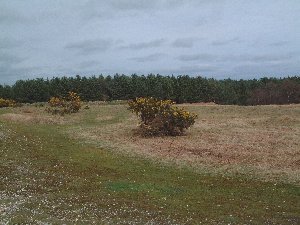
was at Rendlesham Forest on the 21st March. Here we had been given directions
to the best area of acid grassland in the forest. On driving past the area
to set up some lights in another part of the forest we were not very impressed
as the grass looked rather rank and rabbit-grazed and it seemed likely
that we were in for another blank night. On returning to the area of grassland
when night had fallen we were rather surprised to find a Lunar Yellow Underwing
larva almost straightaway, followed by over twenty more larvae as the searching
continued. The larvae were largely found amongst the taller clumps of grass
growing around the bases of bramble plants. The areas in between the clumps
being largely rabbit-grazed. Areas where bracken was present amongst the
grass had very few larvae.
 |
|
|
Neil Sherman subsequently found a further singleton larva at Ipswich Golf Course on the 22nd March at the same location.
One thing common about both the sites is that the larvae were not found on particularly fine grasses which the textbooks state the larvae prefer, although a search of particularly rank grass at another site in Rendlesham yielded no Lunar Yellow Underwing larvae at all.
Thanks to those who
helped with the survey this year. I think its rather too early to draw
any conclusions from the limited results we have had so far. No doubt the
survey will continue next year, so if you are interested in coming along
then drop me a line.
Some of the Dioryctria can give problems with identification, notably D. simplicella and D. abietella due to their variability and similarity of genitalia. Fortunately, it appears that D. sylvestrella should be readily identifiable. D. sylvestrella tends to be the largest of the Dioryctria and is most likely to be confused with D.abietella. The feature to look at to distinguish the two is the sub-terminal line on the forewing; this is smoother in D. sylvestrella but in D. abietella is rather dentated in its more dorsal portion. In addition, the sub-terminal line approaches the dorsum almost at a right-angle in D. sylvestrella whereas in D. abietella the sub-terminal line approaches the dorsum at an angle.
Further details can be found in the Atropos articles listed below :
[1] Parsons, M. & Clancy, S. (2002). Dioryctria sylvestrella (Ratz.) - New to Britain and Ireland, and the Identification of the British Dioryctria Species. Atropos. 15 : 16-18
[2] Clancy, S. (2002).
Further British Records of Dioryctria sylvestrella. Atropos. 16
: 78
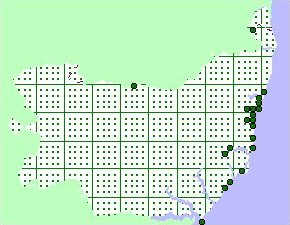
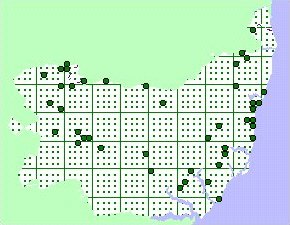
For reference the
two maps below show the distributions for the Saltern Ear and Ear Moth
records that we have for Suffolk.
 |
 |
|
|
|
|
[1] Goodey, B. (2000).
Is the Large Ear Amphipoea lucens (Freyer) (Lep.: Noctuidae) resident
in south-east England?. Entomologist's Rec. J. Var. 112 :
106
 |
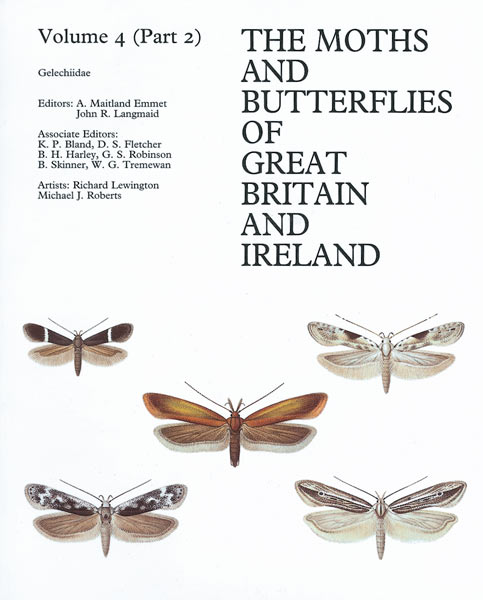 |
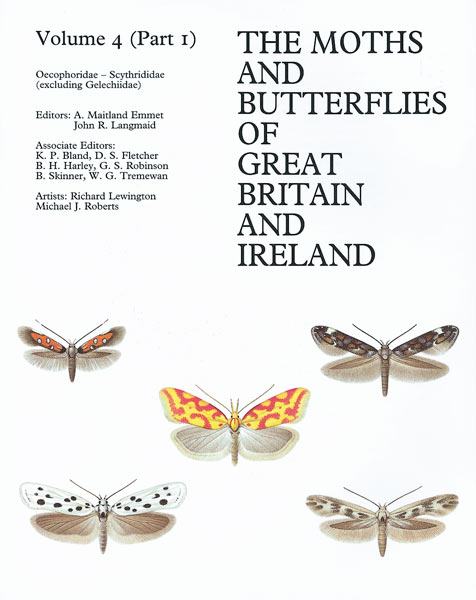
For those people who are familiar with this series Volume 4 carries on where Volume 3 finished off. It seems like it has been a long wait for this volume but one that has been worthwhile, judging by the quality and the thickness of the books. For those who are not this is the 'fourth' volume in a series of ten intended to be a standard reference work covering all the lepidoptera of both Great Britain and Ireland. The first volume in the series was published in 1976 and volumes have appeared periodically since. The existing seven volumes cover the butterflies, the macro-lepidoptera excluding the geometrids and the microlepidoptera families up to the Gelechiidae. Volume 7 part 2 also includes a life history chart covering the whole of the lepidoptera for Great Britain. The plates in the earlier volumes were of rather poor quality but in later volumes Richard Lewington has produced the plates and some of the other drawings and these are of the high quality we have come to expect.
As this series has been produced the volumes seem to have got thicker and with Volume 4 the amount of material to be included led to the decision to publish the volume as two parts. Part 1 covers the families; Oecophoridae, Ethmiidae, Autostichidae, Blastobasidae, Agonoxenidae, Batrachedridae, Momphidae, Cosmopterigidae and Scythrididae with an introductory chapter on ‘The Ecology and Evolution of Lepidopteran Defences against Bats’. Part 2 covers the family of Gelechiidae only. Existing literature for these families has been rather limited and it is hoped that this work will increase interest in these previously poorly recorded families.
As I'm no expert on the families covered by Volume 4 I cannot really comment on the technical accuracy of the text. The authors who wrote the systematic sections include many notable and familiar names so I'm expecting they've got it right. The format of the systematic section follows that in previous volumes with detailed descriptions of the adults, life history, distribution and a vice-county distribution map for each species. Checklists and keys to the adults are provided for each of the families covered and there are genitalia drawings of both sexes for each species. The impression I get on reading the various species accounts is that there is more useful information on how to locate the species in the field than in previous volumes, with interesting aspects of life history included where appropriate. The text reads well considering the high density of information present - there's a huge amount of information contained in these books!
If you are interested in microlepidoptera then this book is a must-have. If not then may you'll be tempted to start having a go at some of these families when you've seen this book.
Details for Part 1 : 324pp., including 13 colour plates, 95 text figures and 146 species maps; and for Part 2 : 280pp, including 6 colour plates, 63 text figures and 161 species maps.
The paperback version of this volume (which is expected to be available 1st September) is being offered for £82.50 for the two volume set or £44 for single volumes. The hardback volumes are available at £150 for the two volume set and £80 for single volumes.
A list of corrections found since publication is being produced and can be obtained by sending a SAE to the publishers. This list will be included with the paperback version when it is released.
Harley Books (B.H.
& A. Harley Ltd.) can be contacted at Martins, Great Horkesley, Colchester,
Essex CO6 4AH. Telephone 01206 271216. Web site at www.harleybooks.com.
Email : harley@keme.co.uk
The following lists the currently known errors
 |
 |
|
|
|
|
|
|
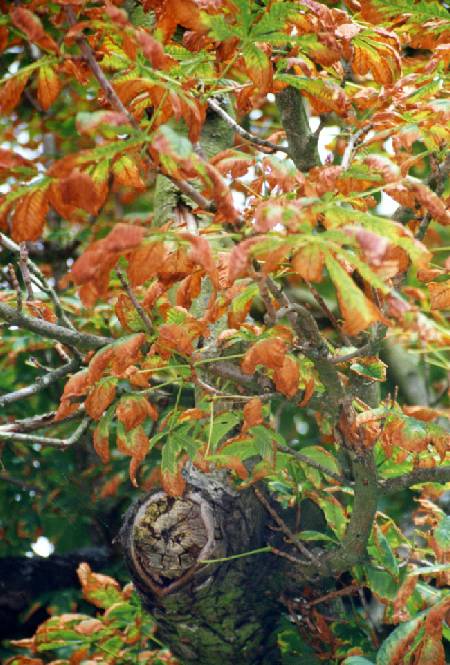
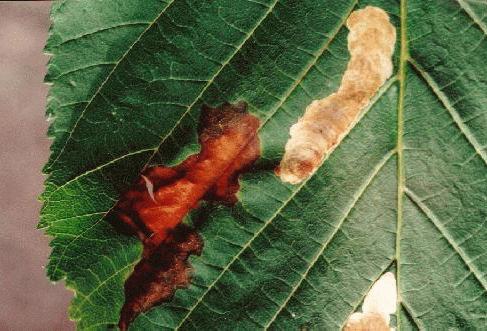
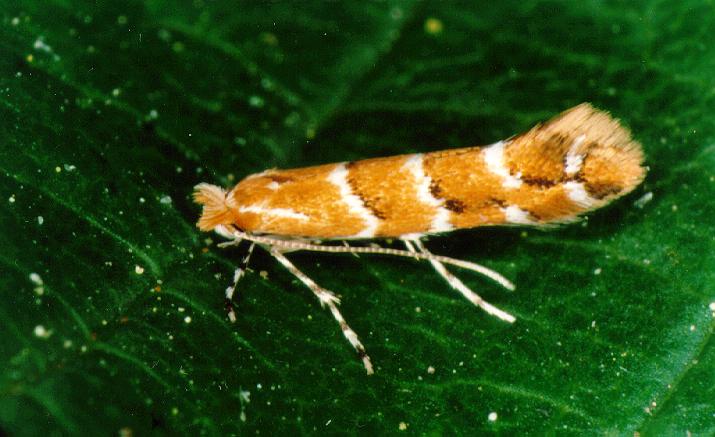
The species is a member of the Gracillariidae and was first recorded and described in Macedonia in 1985. The moth then appeared in Austria in 1989 (with a suspicion that it was an escapee after a moth collector was breeding the species). Since then it has spread rapidly across Europe, east and west, and is now present in France, Belgium and Holland. It would seem to me that given the rapidity of this species' spread across Europe and the fact that it is just across the Channel from us then it is only a matter of time before this species appears in the UK.
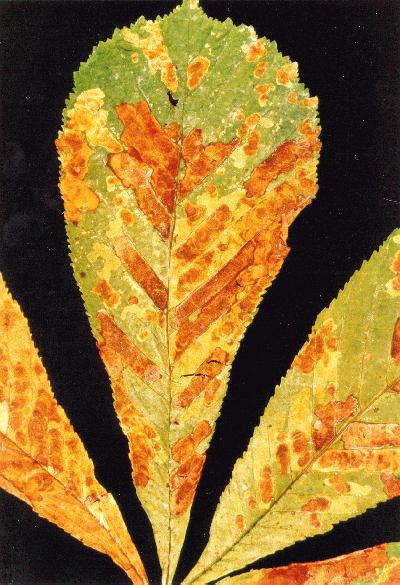
In line with most other Gracillariids the larvae of this species are internal leaf-miners, starting with a sap-feeding instar moving onto tissue eating from the second instar. The pupa is formed within the mine. The mine is brown in colour and quite obvious on the leaf. As there may be up to several hundred mines per leaf the effect on the appearance of the tree is marked and affected leaves tend to drop early from the tree.
The species has been reported from other species of Aesculus, including Aesculus pavia. Where Acer pseudoplatanus, sycamore, is found to be growing under horse chestnut trees it has also been found to attack the leaves of this tree as well.
In the warmer European
climes the moth may have up to five generations a year, although in Germany
it only manages three. Once established the moth population increases rapidly
within one or two years.
 |
 |
|
|
|
|
|
|
The identification of the mine on the tree is relatively easy as there are few species which feed on horse chestnut. The tree suffers from a brown mould (Guignardia aesculi) which may lead to some confusion but the presence of a larva, pupa or frass within the mine should readily distinguish the mine from the mould.
If you are passing
any horse chestnut trees then it might be worth keeping an eye out for
the mines - there's always the chance it could turn up in Suffolk first.
Increasing numbers of moth groups have web sites and the Lanchashire Moth Group was one I came across recently at www.lancashire-moths.org. It is not the easiest sites to navigate around and does not appear to have been updated for some time but does have some interesting articles to read.
For those interested
in conservation the UK Biodiversity web site may be of interest. The site
gives a background to biodiversity conservation, has online versions of
the species action plans for the UK and various other sections including;
news, research, contacts and a search facility. I suspect that the action
plans will be of most interest to moth recorders although the facility
to search for an organisational contact may also come in useful. This site
can be found at www.ukbap.org.uk
The Yellow Horned was noticeable in its abundance – the highest count coming on the 17th when 22 were caught. Also regular was the Small Brindled Beauty, with a maximum of 16 appearing on the 4th before tailing off as the month progressed. This moth seems to have been increasing in recent years here. Oak Beauty is always nice to see – the 10 caught on the 17th was the highest count. Early Grey (17th), Red Chestnut (21st, 31st) and Early Thorn (21st, 31st) all appeared on time. However, 2 species seen were out of season (going on previous records at this site): Water Carpet (a fresh one on the 17th with another on the more normal date of 31st) and Frosted Green (on the 21st).
On the micro front, very little was seen apart from the numerous Tortricodes alternella and Diurnea fagella. Of possible interest were Ypsolopha ustella (2 on the 17th) and Alucita hexadactyla (3 trapped on the 21st). The first of what will be many Eriocrania subpurpurella of the year appeared on the 31st.
One of the main activities I have been involved in this month has been nocturnal searches for the Lunar Yellow Underwing larva. One of the various heathland sites searched has been the golf course (although the first attempt on the 16th was a washout, as all that were present will remember well!). Single larvae were found on the 17th and the 22nd, in the same area of the site (an area of fine leaved acid grassland, on the back of a bunker!), confirming this BAP species breeds here. Habitat management is already in place to increase the amount of acid grassland present so hopefully the moth will increase in the future. Several other types of caterpillars were also found: Square-spot Rustic (common everywhere – even in my garden), Yellow Shell, Lunar Underwing, Lesser Yellow Underwing, Large Yellow Underwing (all feeding on various types of grasses) and Small Angle Shades (found on Broom).
An unusual sighting occurred on the 11th – a female Pale tussock was found in the tea shed! It must have pupated inside last year and hatched out as it was warm inside.
Towards the end of the month, the Orange Underwing was noted on its daytime flight around silver birches (maximum of 4 seen on the 18th) on sunny afternoons. Also found during the day while lifting turf was a Lime Hawk-moth pupa – this has been retained so the rest of the greenstaff can see the imago.
April 2002 will be remembered as being one of the warmest in recent years. It was also very dry, with rain only appearing at the end of the month. To begin with, nights were cold and clear but towards the latter few weeks temperatures were well above average. A few moths normally out in May appeared, joining the usual suspects at this time of year. Lights were run on 6 occasions, which along with daytime observations produced a list of 12 micros and 46 macros for the month.
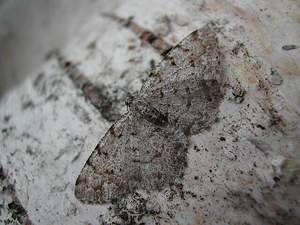
Normal April macros included: Lunar Marbled Brown (max. 28 on 25th), Brindled Beauty (1 on most nights), Frosted Green (max. 20 on the 18th), Muslin (appearing in the latter part of the month), Least Black Arches (21st), Purple Thorn, Shoulder Stripe (3rd), Early Tooth-striped (25th) and March Moth (1 on 25th). Prominents also started to appear, with Lesser Swallow, Swallow, Iron and Great being recorded. One of my favourite moths, the Chocolate-tip was also seen (25th).
More unusual (for
the time of year) were: Grey Birch (3rd), Cinnabar (21st), Maiden’s Blush
(21st), Dwarf Pug (also on the 21st), Grey Pug (22nd) and Orange Footman
(22nd also).
The most common
micro during the period was Eriocrania subpurpurella, with c.400
appearing on the 22nd. This species is the second most recorded moth for
the site (1386 records - top of the list is Tortrix viridana
with
1806 records). Epinotia immundana also appeared, but not quite in
such numbers! Another very common sighting during the day were the swarms
of Adela reaumerella flying at all levels around Oak trees – impossible
to count!
On the 10th, whilst
walking past the Leylandii hedge next to the clubhouse, I noticed quite
a few small green larvae hanging off silken threads attached to the bushes.
After collection they pupated and were passed to Tony Prichard. When the
adults emerged they turned out to be Argyresthia cupressella, an
adventive species first discovered in Suffolk a few years ago (1997
was the year - TP).
 |
|
|
|
|
A check of the bat
boxes on site on the 10th revealed no bats but 5 larvae of the Centre-barred
sallow had taken up residence in one box – this total is higher than the
number of times the moth has been seen here in 8 years (only twice!). The
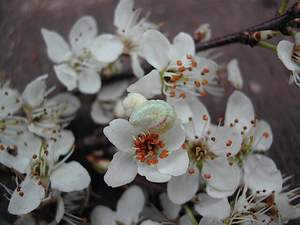
Sloe Pug was also confirmed as a breeding species when a larva was found
by beating flowering blackthorn on the 9th. Another pug larva, this time
found by searching, was seen on the 18th – the Green Pug, hidden inside
its spun up crab apple flower.
 |
|
|
|
|
A daytime search
of wood sage in the breeding area for Capperia britanniodactylarevealed
the first larva on the 24th. The feeding signs are quite distinctive once
known as they bite partially through the top part of a stem, causing it
to wilt. The larva then hides within this shelter. Also flying around at
this spot were several Common Heaths.
The Lime Hawk-moth
pupa collected last month hatched at the end of the month, and was much
appreciated by all the staff who saw it. Just wait until the Privet Hawk-moths
appear, I told them. They are even bigger!
Of possible interest were: May Highflyer (first of the year on the 18th), Currant Pug (also on the 18th), Dwarf Pug (another record on the 16th after previous ones last month), Broom-tip (16th), Brindled Beauty (having a good year appearing regularly), Brindled White-spot, Orange Footman (another species having a good season with the highest count of 22 on the 18th), Alder Moth (one of this smart moth on the 19th), Green Silver-lines (first for the year on the 30th) and Buttoned Snout (the second site record on the 18th).
Micros also increased in numbers and variety. Species of note included: Monopis obviella (19th), Tinea trinotella (18th), Phtheochroa rugosana (a worn individual on the 19th), Epinotia subocellana (18th) and Nemophora degeerella (with its impressive long antennae on the 30th).
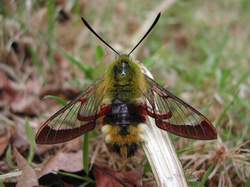
A female Emperor
moth was found by the Course manager on the 2nd, on the flowerbed next
to the clubhouse where larvae were seen last year – it impressed all onlookers
before flying away, most golfers who saw it not realising that such big
moths occur in this country. Other interesting daytime discoveries included:
Pine Hawk-moth (first of the year) on the clubhouse wall (20th), Flame
Carpet (10th) and a Broad-bordered Bee Hawk-moth that was trapped in the
polytunnel containing our stocks of gorse plants (21st - only the third
sighting of an adult moth on the site – larvae are found commonly every
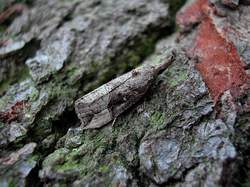
year on honeysuckle). An unusual form of the Green Carpet was seen on the
19th – most of the dark markings across the centre of the wing were missing,
with there only being 2 circular dots. This made the moth almost entirely
green in colour.
 |
 |
|
|
|
|
|
|
|
|
A few caterpillars
have been found this month with the Drinker (on the 27th) being the most
impressive. Also seen were Pale Brindled Beauty, Twin-spotted quaker and
Hedge Rustic.
The first
migrants of the year also appeared during the moth, with 2 sightings each
of Plutella xylostella and the Silver Y.
This year, the season got off to a very slow start with no moths recorded during January and February. The trap was put on just 5 times during March, with one night recording no moths at all. Just a handful of species were recorded, 10 in fact, with only small numbers of each being seen. However Dotted Border, Hebrew Character, Common Quaker, Small Quaker, Early Moth, March Moth, Engrailed, Clouded Drab and Early Grey were all recorded. A single Yellow Horned was spotted by one of our volunteers on the outside of the chalet on the 7th.
April was not a productive month, not suprising as the trap was only put on twice. However, Oak Beauty and Pine Beauty were added to the list.
May has been much
more productive with the trap run on average twice a week. However, the
number of species caught in one night has not yet exceeded 20. The start
of the month was particularly noteworthy for the amount of Brindled Beauties
turning up. These faded by mid month, though the occasional one still puts
in an appearance. A male emperor moth was brought in to the visitor centre
on the 5th, apparently found along one of the trails. It was later returned
to the spot it was taken from. Plenty of Great Prominents have been
seen. The 12th saw Chocolate-tip, Scorched Wing, Bird's Wing, Dark-barred
Twin-spot Carpet, Yellow Belle, Heart and Dart and lots of Lesser Swallow
Prominents. The 20th also proved to be a good night. The first hawk-moth
turned up – a Poplar Hawk-moth, as well as Tawny Shears, and plenty of
Brown Silver-lines and Treble Lines. The end of the month saw yet
more species added to the year list including Cream-spot Tiger, Fox Moth,
Buff-tip, Common White Wave, Silver-ground Carpet and Light Brocade.
Regular trapping started in earnest at the end of March with the highlight being a Pine Beauty on the last day of the month. Little did I know, but this was the start of what has turned out to be a good run as thirty-five new species have been added to the garden list so far this year. Generally, however, catches were small and mostly consisted of the odd Early Grey, Common Quaker or Hebrew Character. The only other highlight was a single Early Thorn trapped on the 30 March.
Things definitely started to pick up during April and May. The first Shuttle-shaped Dart appeared on the 17 April but, judging by the records since, it’s going to be another race between Heart & Dart and Buff Ermine to see which species becomes the commonest garden visitor in 2002. Currently the money is on Heart & Dart. A Mullein trapped on 22 April (another new species) was the prelude to what must go down as one of my better days this year. Trapping two nights later produced only thirteen species (seventeen moths in total) but no less than six of these were new – Esperia sulphurella, Brindled Pug, Waved Umber (seen again at the start of May), Lunar Marbled Brown, Nut-tree Tussock and a superb Herald (sorry no pictures folks). Spruce Carpet and Coxcomb Prominent also joined the party during May as well as the more usual species on the wing at this time of the year. On the other hand micro’s were generally conspicuous by their absence – the highlight being a Nematapogon swammerdamella on 27 May, a species with an apparently poorly known distribution in the county.
June has been very productive, probably helped by the use of my MV trap on more than one occasion. Trapping on at least three nights with my MV drew in a total of thirty-six, thirty-eight and forty-four species. Not to be outdone the actinic mustered at least twenty plus species on two nights and an impressive thirty-six on 24 June. With so much to choose from I shall try to pick out a few highlights. New micro’s included Monopis obviella and Telioides luculella (2nd), Gypsonoma dealbana (24th) and Dichrorampha petiverella (26th) as well as Epinotia abbreviana on the latter date. Of the macro’s Eyed Hawk-moth has finally been lured to the trap. Two were caught at the end of the month (26th), the same night that I had my first Hornet (the big, stinging variety) in the garden. Other newcomers included The Shears, Light Brocade and Clouded-bordered Brindle on the 6th, a female Ghost Moth and a Bordered White on 16th and a Plain Golden-Y on the 19th. Backed up by a good smattering of the more expected species, including a mixture of pugs and carpets, the good old Thurston Wave (sorry, Treble Brown-spot), Swallow-tailed Moth, Flame, Green Silver-lines and Spectacle to name but a few, it has been an enjoyable end to the first half of the year.
So, with the garden
list currently standing on 282 species (and with a few micro’s still awaiting
identification) will I make it to the 300 species mark by the end of the
year. A cold and wet start to July might not bode well but who knows –
stay tuned folks!!
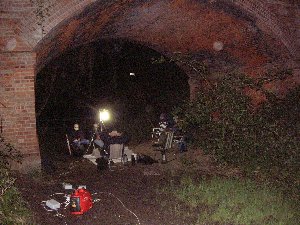
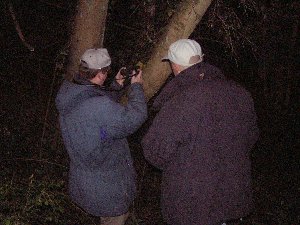
More of interest was to be had at the lights with some spring species recorded; Lunar Marbled Brown, Frosted Green and Red Chestnut. Large numbers of Agonopterix umbellana were noticed flying in the vicinity of the gorse bushes as we searched by torchlight for larvae.
 |
 |
|
|
|
|
The sheet was in a rather exposed position as it turned out and did rather poorly. Fortunately we were saved again by having some traps in more sheltered areas.
Species of note included;
Clay Triple-lines, Red-green Carpet, Cream Wave, Pale-shouldered Brocade,
Red Chestnut, Marbled White-spot, Nut-tree Tussock, Large Nutmeg and Orange
Footman. Orange Footman seems to be going from strength to strength in
the county in recent years and this year would appear to be continuing
the trend.
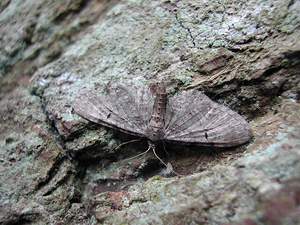
Moths of note recorded included; Fox Moth, Clouded Buff, True Lover's Knot, Pale-shouldered Brocade, Shoulder-striped Wainscot, Clouded-bordered Brindle, Small Clouded Brindle and May Highflyer
 |
|
|
|
|
Other species recorded include; Monopis monachella, Neofaculta ericetella, Orange Footman, Lunar Yellow Underwing, Broom Moth, White-point and Marbled White-spot
Other species of interest were; Endothenia quadrimaculana, Evergestis extimalis, Sitochroa verticalis, Nascia cilialis, Grey Carpet, Pale-shouldered Brocade, Dog's Tooth, Reed Dagger, Small Clouded Brindle, Large Nutmeg, Cream-bordered Green Pea and White Colon,
One hundred species
record on the night with Epinotia subocellana,
Phlyctaenia perlucidalis,
Nascia
cilialis, Small Seraphim, Purple Clay, Ingrailed Clay, Bird's Wing,
Clouded-bordered Brindle, Small Clouded Brindle and Miller being of most
interest.
Please send any
Suffolk moth records, moth articles or other queries to myself (preferably
via email) at :
3 Powling Road, Ipswich,
Suffolk IP3 9JR
Email : tony.prichard@btinternet.com
(also tony.aw.prichard@bt.com
)
Suffolk Moths web site (home of the SMG): http://www.btinternet.com/~tony.prichard
SMG Email Discussion Group: http://groups.yahoo.com/group/suffolkmothgroup
Essex County Moth
Recorder : Brian Goodey, 298 Ipswich Road, Colchester, Essex. CO4 0ET.
E-mail: brian.goodey@dial.pipex.com
Good quality at low prices
Full range of entomological
supplies.
MV and actinic Moth traps.
MV, Blended and Black bulbs
in stock. Dissection equipment, Chemicals, Microscopes, Generators, Entomological
cabinets, collecting tubes etc.
For full details send a
SAE to:
PO Box 232, Northwich Delivery
Office,
CW8 3FG. Or phone 01263
862068
Website : http://www.angleps.btinternet.co.uk/
Proprietors: J Clifton & A Wander