Suffolk Moth Group Newsletter
Issue 29 - Summer 2003
Edited by Tony
Prichard
In this issue
Editorial
Another season is well
under way and it has been a good year so far for migrants in the county.
I have received many reports of Hummingbird Hawk-moth and Silver Ys. Landguard
have had some very notable records with Pale-shouldered Cloud (x2), Spurge
Hawk-moth and Tree-lichen Beauty. Recorders generally have been reporting
that the season so far has shown a marked improvement on recent years -
reminiscent of the mid-1990s.
The events list has
been progressing well apart from the annual lack of success with the nighttime
larval hunt. This year we have seen several new faces appearing at the
moth night meetings, which is encouraging as news of the moth group spreads
within the county and elsewhere, even more encouraging is that the new
members have come back again for further meetings.
Surveys this year
have had mixed success; Marbled Clover and False Mocha have gone poorly
whereas Buttoned Snout has been surprisingly successful - more on these
later in the newsletter.
One of the key features
within the newsletter is the reports from recorders around the county.
I am keen to encourage more recorders to provide summaries of their recent
findings for this section - it saves me thinking of what to write and is
probably more interesting. The format of this section is completely flexible
and articles can be either short or long (but not too long), whatever takes
your fancy. The key aspect is that they reflect what the recorder thinks
is of note - I would not be too worried about the significance of records
from a county/countrywide context. The next issue of this newsletter will
probably be out in early September so I'd be grateful to any recorders
who could provide recording summaries for July and August for the next
newsletter or any other articles that may be of interest. It's your newsletter
after all.
A planning phase
is under way for a national macro-moth recording scheme for Britain. I
have had some involvement as a representative for of an active moth group.
This could be a truly significant project pulling together data on a national
level but it is still early days yet - more details later on.
Cnephasias
in
Suffolk - Jon Clifton
This brief article summarises
the distribution in Suffolk of this small group of drab, mainly dark moths
belonging to the Tortricoid family. There are nine species that occur in
Britain of which seven have been recorded in Suffolk. Due to their similarities
they can be quite tricky to identify in the field and in most cases usually
have to resort to examination of the genitalia for positive identification.
I have been examining
this group for about five years and special thanks must be made to all
those members in the SMG for passing onto me specimens of this group over
the past few years.
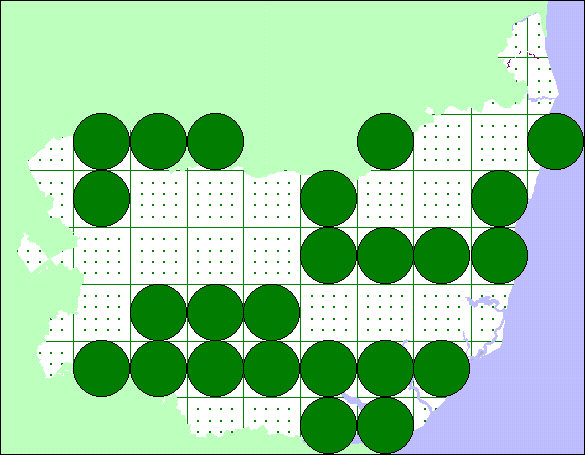
Cnephasia longana
is one of the easiest to identify in the field differing from the other
Cnephasia
by its unicolorous pale ocherous, long forewings. Usually not requiring
examination of the genitalia although some tricky all pale forms have been
recorded and could be confused with other tortricids. In Suffolk this species
is widespread and common and like all the Cnephasia, can be found
over a wide range of habitats from gardens to woodland and along the coast.
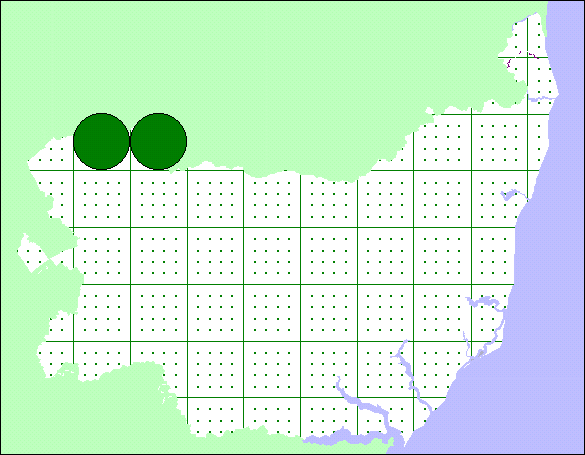
Cnephasia communana
is the earliest of this group to emerge and the only one on the wing during
most of May. About the size of stephensiana and on the specimens
I have seen they usually have a paler ground colour and paler brownish
cross markings (fascia). Overall it creates a more washed out moth than
stephensiana. Only three records all from the Brecks area of Suffolk. It
seems quite likely that this species is very much on the decline so I would
be very interested to hear of any May Cnephasia’s and would be grateful
if recorders could send specimens on to me for checking.
 |
|
 |
|
Cnephasia
longana distribution
|
|
Cnephasia
communana distribution
|
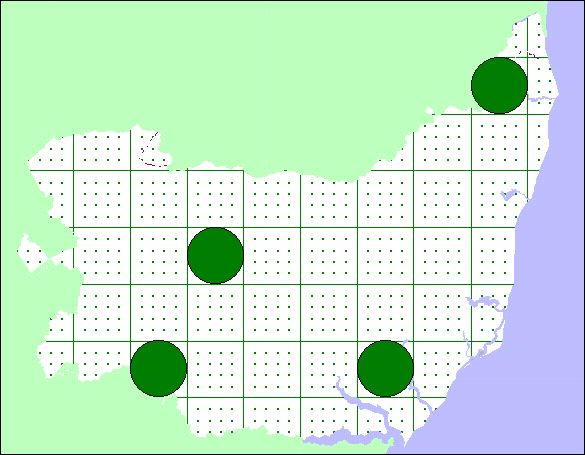
Cnephasia conspersana
resembles C. stephensiana in size but has the apex of the forewing
more pronounced, more ‘pointed’ than in that species, especially noticeable
on the set specimen. The forewing is pale greyish (a paler ground colour
than stephensiana) mixed with darker grey markings. Only four records,
from Ipswich, Great Cornard, the Waverney Valley and Thurston.
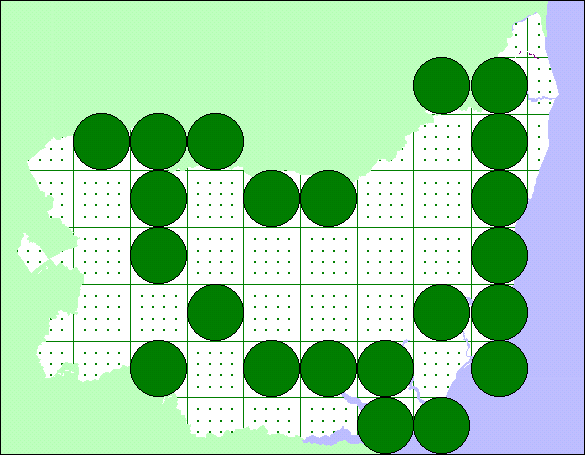
Cnephasia stephensiana
is the largest of the British Cnephasia with relatively broad forewings
having a dark ground colour and dark grey fascia. Although this is true
of most specimens there are small individuals that can resemble incertana
and it is here that caution must be expressed. Along with longana it is
the commonest Cnephasia in Suffolk with widespread records throughout
the county.
 |
|
 |
|
Cnephasia
conspersana distribution
|
|
Cnephasia
stephensiana distribution
|
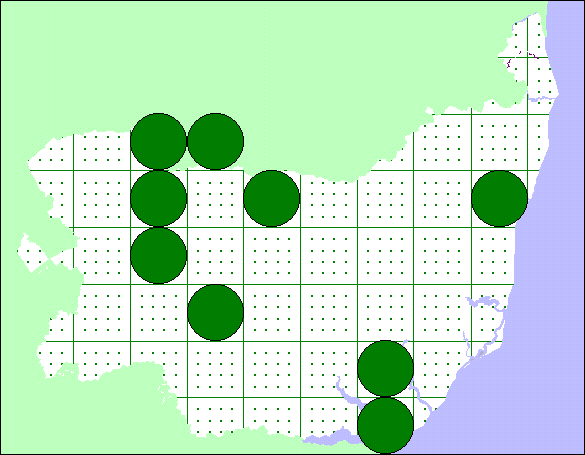
Cnephasia asseclana
is smaller than C. stephansiana but with similar dark markings so
could quite easily be confused with small specimens of that species. I
usually find it has a more scalloped look to it than other Cnephasia.
Quite a common member of the group so I find it odd that although the moth
is fairly widespread in the west of the county (VC26) there are only two
records in the east (VC25). Obviously overlooked.
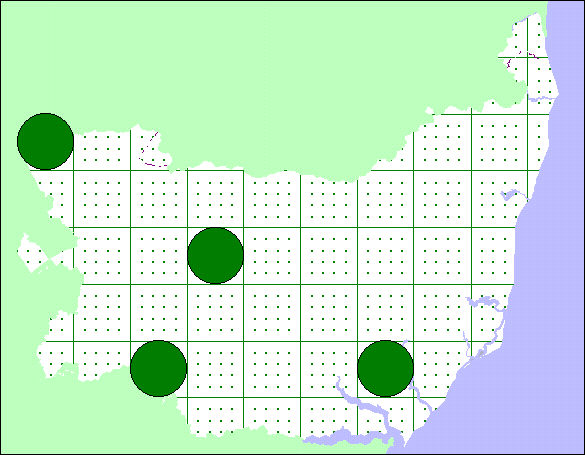
Cnephasia genitalana
at first glance looks like a small worn
Cnephasia and something
not worth hanging on to but this I almost find characteristic of this species
with its pale whitish-grey ground colour and indistinct fascia. First discovered
in Suffolk at Lakenheath Fen in 2000 with further records from Ipswich,
Great Cornard and Thurston. A species that seems to be increasing
in East Anglia.
 |
|
 |
|
Cnephasia
asseclana distribution
|
|
Cnephasia
genitalana distribution
|
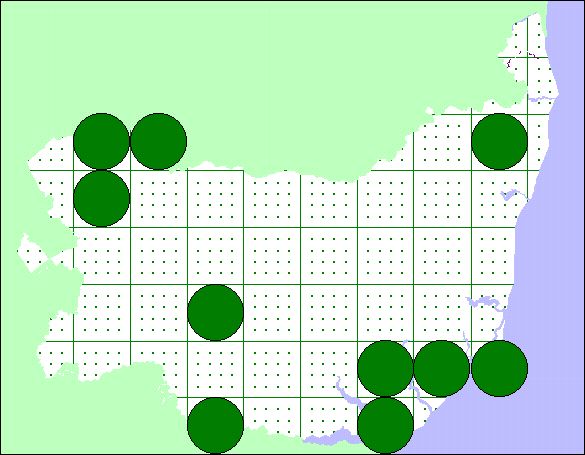
Cnephasia incertana
is another ‘small’ Cnephasia about the size of C. asseclana,
but having paler forewing colour and ill-defined fascia (not as pale as
genitalana). This is another member of the family I believe to be on the
decrease in general in the east and with only a hand full of record’s from
both the east and west of Suffolk it is something to keep an eye on so
any possible specimens are required for conformation.
|
|
Cnephasia
incertana distribution
|
Cnephasia pasiuana.
Although there are no records from Suffolk it is known from Essex and is
a species to look out for. It resembles genitalana in its washed out appearance
and size. Any possibilities will be greatly appreciated.
To conclude, any
Cnephasia’s
in the month of May are worth a second look, we need more information on
Cnephasia
incertana, and all my ‘rarer’ Cnephasia (conspersana,
genitalana
and pasiuana have been taken in late July and into August)
Specimens to be sent
to:
Jon Clifton, Kestrel
Cottage, Station Road, Hindolveston, Norfolk, NR20 5DE.
Announcement
- Towards a National Recording Scheme for Macro-moths
In recent months, Butterfly
Conservation has held exploratory talks on the development of a National
Recording Scheme for Macro-moths with representatives of the British Entomological
and Natural History Society, Royal Entomological Society, Biological Records
Centre, Joint Nature Conservation Committee, English Nature, Rothamsted
Insect Survey and others. These discussions have identified the need for
a thorough planning phase as a first step to towards the establishment
of a new scheme. On behalf of Butterfly Conservation and the other partners,
we are undertaking the planning phase until March 2004.
The three key aims
of the planning phase are:
-
to consult fully with
moth recorders, Butterfly Conservation Branches, local moth groups and
local and national conservation and biological recording organisations
-
to develop the rationale,
methodology, mechanisms, timescale and outputs of the proposed new scheme
-
to develop bids for
long-term funding to enable a macro-moth recording scheme to be set up
and run
Depending on the planning
phase results and on overcoming the considerable obstacle of obtaining
appropriate funds, it is anticipated that a national recording scheme could
be started as early as 2005 or 2006. In the meantime, Butterfly Conservation
will continue to encourage greater awareness of moths and moth recording
and recorders should continue to support local initiatives and county recorders.
As mentioned above, a wide consultation will be undertaken prior to the
launch of the scheme and the active involvement of moth recorders and groups
in the development of a new recording scheme will be sought. In addition
to talking directly to moth recorders and groups, we would welcome your
feedback, thoughts and concerns, which can be directed through our web
site www.recordingmoths.org.uk
or by writing to Adrian Spalding at Spalding Associates, Norfolk House,
16/17 Lemon Street, Truro TR1 2LS.
We hope that we will
be able to count on your support.
Adrian Spalding and
Mark Tunmore
July 2003
(TP. Currently as
I put this newsletter together the website is not yet up but I gather should
be shortly.)
Buckler
Larvae of the British Butterflies and Moths CD Rom
I mentioned in the last
newsletter that a CD version was being produced of Buckler's 'Larvae of
the British Butterflies and Moths'. I understand that the CD of the first
volume is now available from Pisces Conservation. This CD covers the butterflies
and is available for £20 including package and posting. I have not
seen the final product so I cannot comment on the quality - if anyone would
like to buy it and produce a review for the newsletter I'd be glad to hear
from them. The amount of interest shown in this CD will affect the priority
given to the order in which the other Ray Society works are produced. This
could be an opportunity to express your wishes to the publisher as to what
volumes you would like to see produced first (the tortrix volumes come
to mind). Pisces Conservation can be found at www.pisces-conservation.com
or PISCES Conservation Ltd, IRC House, The Square, Pennington, Lymington,
Hants., SO41 8GN. Telephone : 01590 676622.
New
Pug Book - not the one we've all been waiting for or may be it is.
Colin Plant made me
aware of the publication of the book 'The Geometrid Moths of Europe Volume
4' by Vladimir Mironov covering one of the trickier groups of macro-moths.
Identification of this group is not helped by the plate in Skinner not
being particularly clear. The plates in this book, however, are reasonably
clear and images of the set moths in the plates are at x1.5 magnification.
The larger than lifesize images certainly make a difference in picking
out the features. I've not used it too much in real anger yet but the Valerian
Pug recorded at Minsmere was easy to confirm based on the plate and text.
The text is in English and has useful diagnostic features highlighted for
distinguishing similar species. Distribution maps are obviously at a higher
level than a purely British book but are still useful. This would
certainly appear a book worth looking at if you are interested in this
group but it is rather expensive at around £80. ISBN - 87-88757-40-4
published by Apollo Books.
Clearwing
News
Adrian Parr has been
having rather more success than I've had with the pheromone lures. He recently
reported attracting several Red-tipped Clearwings to lures at Hengrave
along the River Lark. I am not aware of any other records of this species
occurring in the county.
Adrian also reports
continued success with Red-belted Clearwing at his local orchard in Barrow.
Marbled
Clover update
One of the species that
was suggested as a species to particularly look out for this year was the
Marbled Clover. Since its peak in the mid-1990s only one or two records
have been received for this species each year. I have done some searching
this year in both the Brecks and the Sandlings without any success. This
has included visits to known sites at Aldeburgh/Thorpeness beach, Sizewell
beach and the Kings Forest. However, I gather that David Young had better
success than me when he saw the moth at Maidscross Hill on the 14th June
2003.
Buttoned
Snout update
This is a species whose
status as a BAP species is a bit contentious with some people. Recent larval
surveys in other south-east counties seem to have shown that the moth is
more prevalent than was originally thought. I and others have searched
in previous years for this larva by beating hop but without much success.
This year, however, has proven more successful with larvae being recorded
from quite a few sites in Suffolk; two sites on the Shotley peninsula on
the 6th July 2003, 11 sites in the south-west areas of the county on the
10th July 2003 and 5 further sites over the weekend by various recorders
(Andy Musgrove, Neil Sherman, Rob Parker and myself). There is still some
time to go out and look for this species - probably until mid-August. The
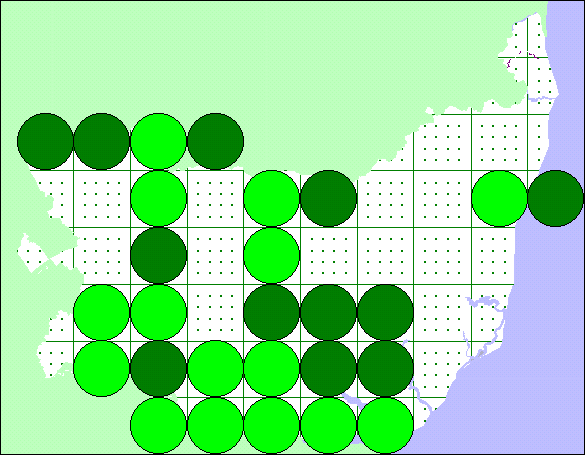
map below shows the 10km squares for which we already have records. It
would be good to increase the number of 10km squares where this species
has been recorded. In the past I have used a beating tray to look for the
larva but these can be awkward to get under the hop leaves, especially
when it is in a hedge, and as the larvae are prone to thrown themselves
off at the lightest touch I have recently been trying a new technique.
Simply taking a butterfly net and stretching the netting to form a flat
round tray makes it easier to place under the hop leaves, without disturbing
the foliage. Rustling the leaves over the net causes the larvae to drop
on to the net - seems to be successful given my limited experience trying
it out so far.
|
|
 |
|
Buttoned
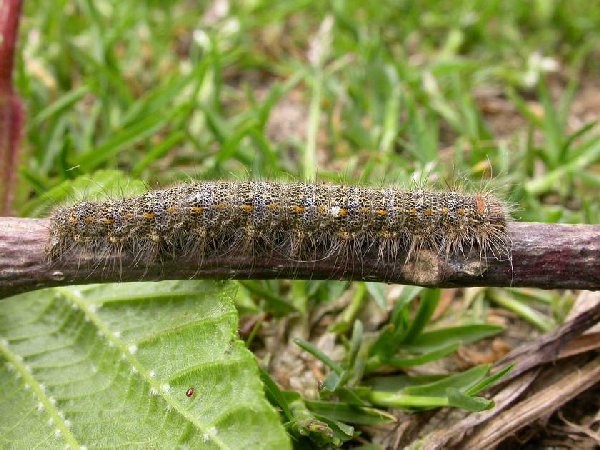
Snout larva © Tony Prichard
|
|
Buttoned
Snout distribution
|
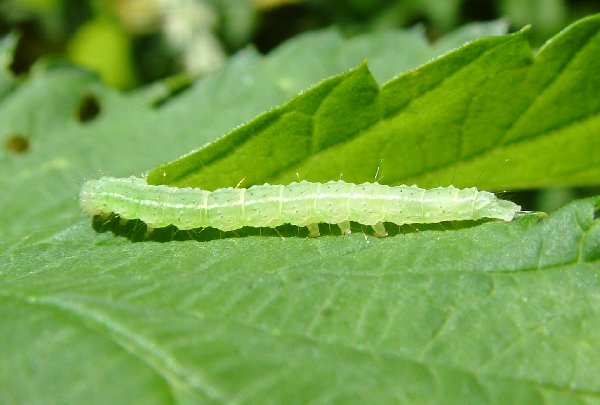
In the picture of
the larva above note the three pairs of prolegs rather than the usual four
pairs found in most noctuids. The light dots on the distribution
map signify squares where larval records have been made this year, whereas
dark dots show squares where we have adult only records.
Some
Top Twenties
As a bit of light relief
here are a couple of table listing the top twenty species for a couple
of queries on the database. The first table shows the top twenty most widespread
species in the county based on the database records.
| B&
F |
Name |
Numbers
of 10km squares |
| 2102 |
Flame
Shoulder |
51 |
| 1713 |
Riband
Wave |
50 |
| 1937 |
Willow
Beauty |
50 |
| 2107 |
Large
Yellow Underwing |
50 |
| 1304 |
Agriphila
straminella |
49 |
| 1738 |
Common
Carpet |
49 |
| 1906 |
Brimstone
Moth |
49 |
| 2092 |
Shuttle-shaped
Dart |
49 |
| 2199 |
Common
Wainscot |
49 |
| 2321 |
Dark
Arches |
49 |
| 2450 |
Spectacle |
49 |
| 1405 |
Mother
of Pearl Pleuroptya ruralis |
48 |
| 2050 |
Common
Footman |
48 |
| 2109 |
Lesser
Yellow Underwing |
48 |
| 2111 |
Lesser
Broad-bordered Yellow Underwing |
48 |
| 2126 |
Setaceous
Hebrew Character |
48 |
| 2128 |
Double
Square-spot |
48 |
| 2160 |
Bright-line
Brown-eye |
48 |
| 2198 |
Smoky
Wainscot |
48 |
| 2441 |
Silver
Y |
48 |
This second table
shows the top twenty most recorded species, simply the species for which
we have the most records.
| B
& F |
Name |
Total
numbers of records |
| 2107 |
Large
Yellow Underwing |
1904 |
| 2102 |
Flame
Shoulder |
1292 |
| 2126 |
Setaceous
Hebrew Character |
1283 |
| 1906 |
Brimstone
Moth |
1198 |
| 2092 |
Shuttle-shaped
Dart |
1179 |
| 1713 |
Riband
Wave |
1105 |
| 2089 |
Heart
& Dart |
1094 |
| 2441 |
Silver
Y |
1078 |
| 2321 |
Dark
Arches |
1050 |
| 2109 |
Lesser
Yellow Underwing |
972 |
| 2477 |
Snout |
934 |
| 2306 |
Angle
Shades |
915 |
| 2199 |
Common
Wainscot |
903 |
| 1405 |
Mother
of Pearl Pleuroptya ruralis |
902 |
| 1738 |
Common
Carpet |
896 |
| 2160 |
Bright-line
Brown-eye |
877 |
| 1937 |
Willow
Beauty |
849 |
| 1728 |
Garden
Carpet |
829 |
| 1076 |
Celypha
lacunana |
822 |
| 2450 |
Spectacle |
820 |
How does this compare
with your garden trap? This latter table in particular I think reflects
the data generated by regularly recorded moth sites providing detailed
data.
Web
sites
You may be interested
in a some new (at least to me) web sites for moth groups.
The Sussex Moth Group
have a site at www.sussexmoths.org.uk.
A rather garishly coloured site - advice is to put on some sunglasses before
visiting this one. It would appear from the site that the Sussex Moth Group
are rather well organised assemblage with a chairman, treasurer, secretary,
etc. The site includes, the group's latest newsletter, programme of events,
how to join the moth group, listing of Sussex rarities and related links.
An interesting point is that the group has annual membership fee of £5
- the SMG must be great value for money in comparison.
The Kent Branch of
Buttefly Conservation have a web site 'Kent Moths' at www.kentmoths.org.
It would appear to be still early days for this site but it already has
a collection of photos, recent news, reports and checklist.
There's also a new
web site for the Dorset Moth group at www.dorsetmothgroup.co.uk.
A well produced site that contains the usual topics covered by most moth
group sites but also has some interesting pages on day-flying moths, migrants
and leaf mines.
Field
reports
Tunstall Common - SMG
Larval Search/Moth Night - 11th April 2003
In the true tradition
of SMG night-time larval search meetings the weather was rather disappointing
with fewer larvae noted than when searching for larvae earlier in the year.
The most interesting event of the night was seeing several Diurnea fagella
males on an oak tree-trunk fluttering their wings and the eventual discovery
of the female that was causing the males to get into a flap.
Minsmere - SBBC Moth
Night - National Moth Night - 12th April 2003
Not a particularly favourable
night but the results were rather pleasing given the weather conditions.
A good selection of spring species were seen. Several of the moth group
went off in search of larvae and this also proved productive, with amongst
others species; Large Twin-spot Carpet and a single final instar Lunar
Yellow Underwing larva in what looked far from ideal habitat. Adults seen
at light included; Water Carpet, Red Chestnut, Early Thorn and Satellite.
Tunstall Common - Moth
Night - 17th April 2003
A rather quiet night
with Narrow-winged Pug, Great Prominent, Pine Beauty and Red Chestnut.
Ramsey Wood - Moth Night
- 18th April 2003
This wood continues
to provide species of interest and at some stage a comparison between
nearby Wolves Wood and this wood, with their different management regimes,
might provide some interesting results. From the 14 species recorded, the
following were of note; Flame Carpet, Frosted Green, Water Carpet and Acleris
cristana.
Rendlesham Forest, Friday
Street - Moth Night - 26th April 2003
A rather successful
night for the time of year in this river valley site hidden amongst the
conifer plantations of Rendlesham Forest. 24 species recorded with Sallow
Kitten, Scalloped Hook-tip, Birch Mocha, Great Prominent, Purple Thorn
and Dwarf Pug being among the more noteworthy.
Rendlesham Forest, Tangham
Valley - SMG Moth Night - 2nd May 2003
This meeting was cancelled
due to heavy rain.
Shingle Street - Night-time
Larval Search - 3rd May 2003
Based on the success
of earlier larval searches we had been bitten by the bug for searching
for larvae and this meeting, held on this private site, was intended
to search for larvae on the vegetated shingle with the hope of finding
Feathered Brindle and Rosy Wave larvae. The former were found in abundance
and rather pretty larvae they were too. No Rosy Wave larvae were found
on the sea beet, although the species seems reasonably well established
here, but searching the sea beet was not completely in vain as a single
Yellow Belle larva was found.
Rendlesham Forest, Tangham
Valley - Moth Night - 4th May 2003
As the meeting on the
preceding Friday had been cancelled this meeting was held as a replacement
and was rather productive with 65 species being recorded. This site is
another river valley passing through the conifer plantations of Rendlesham
Forest with areas of deciduous woodland next to the river and heathland
nearby. Species of interest included; Birch Mocha, Least Black Arches,
Peacock Moth, Alder Moth, Lime Hawk-moth, Argyrotaenia ljungiana,
Emperor Moth, Great Prominent, Narrow-winged Pug, Early Tooth-striped,
Broom-tip, Ochreous Pug, Caloptilia stigmatella, Pseudoswammerdamia
combinella, Knot Grass, Agonopterix ocellana, Metendothenia
atropunctana
and Pseudococcyx turionella,
West Stow Country Park
- SMG Moth Night - 9th May 2003
A rather cool night,
as nights in the Brecks often seem to be. Lights were operated in
the heathy area on the far side of the vistor centre near to the river.
52 species recorded with some expected species including; Pine Hawk-moth,
Narrow-winged Pug, Fox Moth and Teleiopsis diffinis. Searching and
beating nearby trees produced some further records including Copper Underwing
larva and an adult Adela croesella. Other species recorded were;
Chocolate-tip, Scalloped Hook-tip and Streamer but the moths of the night
were a male and female Poplar Kitten found in the same trap as we were
clearing up.
Wolves Wood - Moth Night
- 10th May 2003
It proved to be slightly
warmer in this ancient wood than the previous night with 30 species recorded
on the night. Seraphum, Scorched Carpet, Cream Wave, Poplar Lutestring,
Scalloped Hazel, Chocolate-tip,
Lower Hollesley Common
- Moth Night - 16th May 2003
This is a regularly
visited heathland site in the Sandlings that provided some interesting
results amongst the 36 species, despite the intermittent rain; Orange Footman,
Maiden's Blush, Chinese Character, Purple Bar, Oak Hook-tip, Barred Hook-tip
and
Neofaculta ericetella.
Tunstall Common - SMG
Moth Night - 23rd May 2003
A few visits have been
made to this heathland site in the past for moth trapping and although
the moths were rather slow to come to light 56 species were recorded. Pick
of the bunch were Tinea trinotella, Common Heath, Pseudococcyx
turionella, Pine Hawk-moth, Scalloped Hook-tip, Spruce Carpet,
Neofaculta
ericetella, Monopis weaverella while sitting around the light
we noticed some Incurvaria pectinea mines on birch. Moth of the
night was a singleton Pinion-spotted Pug - currently I've only one other
record for this species in the database. The moth feeds on hawthorn so
it may be surprising that we don't see it more often unless it's shy of
the lights.
Maidscross Hill, Lakenheath
- Moth Night - 24th May 2003
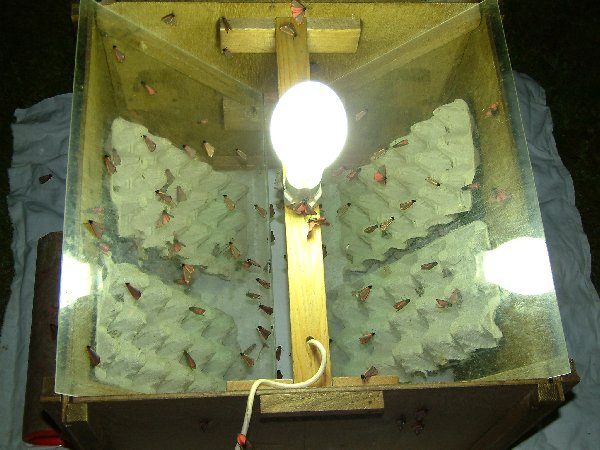
This will probably be
remembered as the night of the Cinnabars, with hundreds of the moth flying
around the light and in the traps. Initially intended as a public meeting
due to problems in making this area a reserve meant that there were just
a few moth group members and members from the Forest Heath District Council.
In all 50 species were recorded including; Buff-tip, Large Nutmeg, Pale-shouldered
Brocade, Aethes cnicana, Campion, Broom-tip, Thisanotia chrysonuchella.
Also
noticed on the Mullein were not surprisingly some Mullein Moth larvae.
 |
|
Cinnabar
moths in Skinner trap
|
Lineage Wood - SMG Day
meeting - 25th May 2003
A rather successful
daytime meeting at this wood that benefits from being on a chalky soil.
Beating of trees and generally poking about for moths and other things
was the order of the day. 34 species were recorded in all. Of prime interest
was the search for Plumed Prominent larvae - a singleton larva had been
recorded here in 9th June 2001 and this year we managed to beat several
individuals from the field maple. Other larvae of note that were beaten
included a few Lackey on oak, a Sprawler on hazel, a Feathered Thorn on
buckthorn, an Ypsolopha parenthesella on hazel. Adult moths noted
included Adela rufimitrella, Ancylis upupana and Marbled White Spot.
Cases of Coleophora laricella were noted on larch and Coleophora
paripennella cases on knapweed and thistle.
Darren Underwood
clocked up a few non-lepidopterous records that may be of interest - nymphs
of the following Bush-crickets; Dark (many), Oak (a few - 6+), Speckled
(one), plus Common Groundhopper, Orange Ladybird, three Short-winged Earwings,
Common Earwigs and the hoverfly Leucozona lucorum (an attractive
spring species whose ideal habitat is lush vegetation in damp woodland
- quite common and widespread, but very nice). I'll skip Darren's bird
records as they probably won't be of interest!
Carlton Marshes - SMG
Moth Night - 30th May 2003
For once we did better
with the weather at this fenland site - previous visits have been dogged
by rain before or during meetings. Of the 65 species nothing was a particular
surprise based on results of previous visits but the following were of
reasonable note;. Reed Dagger, Nascia cilialis, Flame Wainscot,
Gold Spot, Cream-bordered Green Pea, Schoenobius gigantella, Water
Ermine, Small Seraphim, Large Nutmeg, Broom Moth, Campion, Alder, Small
Clouded Brindle, Flame Carpet, Orange Footman, Cream-spot Tiger and Phlyctaenia
perlucidalis.
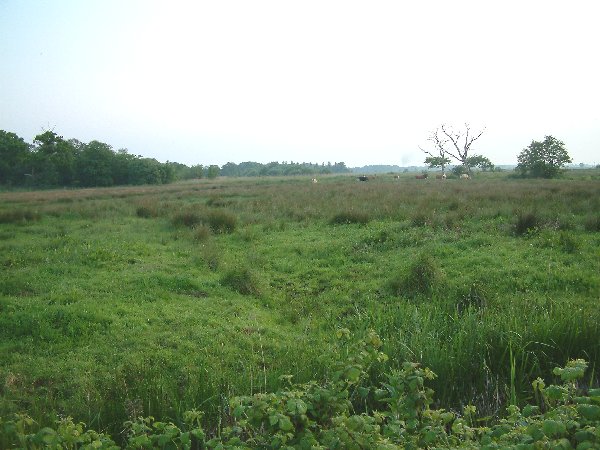
Great Martins Wood -
SMG Moth Night - 30th May 2003
This is a privately
owned piece of woodland south-west of Ipswich. It is on quite light soil
and has large stands of sweet chestnut, however the owner is quite interested
in conservation and within the wood is a small area of heathland that he
is trying to encourage. It was this area of heathland that was of interest
for this meeting as I think it must be the most southerly piece of heath
in the county. A list of 147 species was rather a respectable figure for
this time of year and species that I'd normally associate with heathland
included; Neofaculta ericetella, Teleiopsis diffinis, Cream-spot
Tiger, True Lover's Knot, Narrow-winged Pug and White Colon. A few individuals
of a rather interesting micro, Pseudotelphusa scalella, also made
an appearance. This was recorded in Ipswich in 2002 and was a first for
the county, as far as I am aware. This turned out to be a new site for
the local BAP species Shaded Fan-foot. Other species of note included;
Perinephela
lancealis, Brindled White-spot, Scorched Wing, Grey Birch, Lobesia
reliquana (an infrequently recorded species), Broken-barred Carpet,
May Highflyer, Treble-bar, Eulia ministrana, Dingy Shell,
Prays
fraxinella, Pretty Chalk Carpet, Clouded-bordered Brindle, Beautiful
Golden Y, Miller, Poplar Lutestring, Eana incanana, Spruce Carpet,
Oak-tree Pug, Ochreous Pug, White-point, Alder Moth, Orange Moth, Hypatima
rhomboidella, Argyresthia cupressella, Lobster Moth, Pale-shouldered
Brocade and Ancylis mitterbacheriana
Barnhamcross Common
- Moth Night - 7th June 2003
A meeting intended to
look for the False Mocha, following concerns expressed about its apparent
decline across the country. False Mocha has previously been recorded at
this site (14th May 2001) but this time we were unsuccessful despite operating
phosphorescent traps (low powered lights) near scrub oaks. In all 132 species
were recorded and the highlights were; Cream-spot Tiger, Fox Moth, Tinea
semifulvella, Small Elephant Hawk-moth, Marbled White Spot, Clouded
Buff, Spruce Carpet, Scorched Wing, Cream Wave, Pempelia formosa (plent
of elm nearby), Clouded-bordered Brindle, Four-dotted Footman, Shaded Pug,
Phtheochroa
sodaliana (quite restricted in its distribution), Piniphila bifasciana,
Sitochroa
verticalis, Lobster Moth, Broom-tip, Orange Footman, Satin Wave, Bird's
Wing, Large Nutmeg, Campion, Wood Carpet, Alder moth and Broom Moth
Aldeburgh/Thorpeness
- SMG Moth Night - 13th June 2003
One of the species that
I had asked recorders to look out for in 2003 was the Marbled Clover and
this meeting was intended to search for the moth at this known location.
A slight breeze at this exposed sight meant that activity around the sheet
was rather low but some well positioned traps in more sheltered areas produced
a list of 106 species on the night. While setting up some nearby blackthorn
bushes were noticed to hold large numbers Yponomeuta padella larval
webs. Other species of note included; Fox Moth, Cream-spot Tiger, Shaded
Pug, Water Ermine, Bordered Sallow, Cream-bordered Green Pea, Flame Wainscot,
Southern Wainscot, Campion, Silky Wainscot, Eudonia pallida, Dog's
Tooth, Small Clouded Brindle, Tawny Shears, White Colon, Dotted Fan-foot,
Schoenobius
gigantella, Dusky Brocade, Paraswammerdamia albicapitella,
Coleophora
mayrella and Aethes beatricella.
Kings Forest, Chalk
Lane - SMG Moth Night - 20th June 2003
This night followed
a now familiar pattern in the Brecks of a sunny day with clear skies followed
by cold night and not much in the way of moth activity. This was rather
unfortunate as we had been joined by some people from out of county who
had come especially to see some Breckland specialities. On the upside there
was no lingering presence from a 'rave' held on the site the previous weekend.
Of 24 species recorded the ones of most interest were Piniphila bifasciana,
Fern, Four-dotted Footman and Pine Hawk-moth.
Newmarket, Animal Health
Trust - SMG Moth Night - 27th June 2003 (Paul Bryant)
After what had been
a promising day weather wise, our first foray proper into the Newmarket
area turned out to be a rather wet affair. The original plan had been to
run a small number of traps along a tree lined avenue on the western boundary
of the estate (mostly Beech) and in two isolated patches of Hawthorn, Lime,
Oak & Pine in the adjacent paddock area. However, the wet and windy
conditions soon put paid to this and, after spending a good hour or so
sheltering under the trees in the car park, we decided to run a very basic
sheet where we were and an actinic trap not to far away. With the rain
eventually clearing through by about 10.30pm we put two more MV traps out
but by then the damage had already been done. A total of 51 species were
recorded on the night although the general consensus of opinion was that
given better conditions, the site would have been much more productive.
On the plus side, all bar one or two species were new for the Newmarket
10km square. The highlights were confined to the micros with six species
currently known to be of only local or unknown distribution throughout
the county – Coleophora trifolii and Coleophora mayrella,
Batia
lunaris, Apotomis capreana, Eucosma obumbratana and Cydia
fagiglandana.
Finally, and on behalf
of the group, may I extend our sincere thanks to Keith Read at the Animal
Health Trust for making the whole thing possible.
Aldeburgh/Thorpeness
- Moth Night - 28th June 2003
As Marbled Clover records
seemed to be low on the ground this year we decided to return to this coastal
site with the hope of recording Marbled Clover. The species has been recorded
at this site in the past including records at light. Unfortunately, we
failed to record any of this species but as conditions were calmer moths
were more numerous at the lights and we recorded a few more species (112)
than the previous visit. In the past we have visited this site many times
and thought that it would be a good site for migrants but up until this
evening had been disappointed. A hawk-moth arrived at the sheet light in
the middle of the session and raised some excitement as we tried to net
it while it buzzed around. A potentially rash call of Striped Hawk-moth
based on in-flight identification proved to be correct when it was finally
netted. A notable migrant at last! We did rather well for hawk-moths on
this night with 6 other species noted; Privet, Lime, Eyed, Eyed, Poplar,
Elephant and Small Elephant. Other species of interest included; Dotted
Fan-foot, Blackneck, Star-wort, Shore Wainscot, White-point, Kent Black
Arches, Water Ermine, Grass Emerald, Phlyctaenia perlucidalis, Thiodia
citrana and Platytes alpinella.
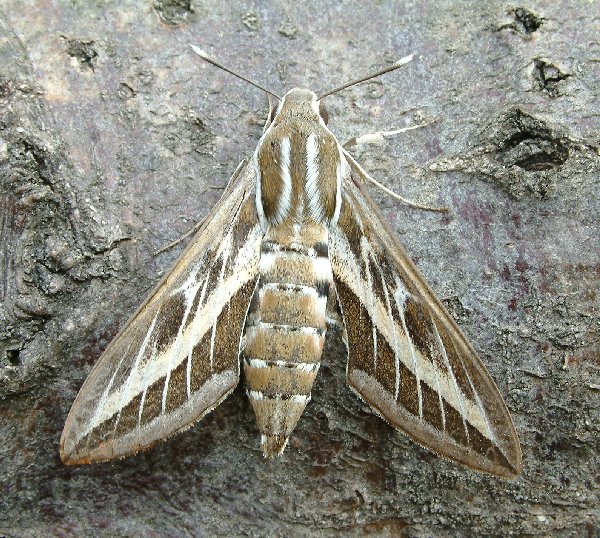 |
|
Striped
Hawk-moth © Tony Prichard
|
Reports
from Recorders around the county
Eye,
January – June 2003 - Paul Kitchener
As it seems with most
sites this year the first four months in Eye were very uneventful with
low numbers of species and individual moths, but things abruptly picked
up in May, and June continued that trend with some very big and varied
catches. Several species were recorded for the first time and, encouragingly,
quite a few others were seen for the first time in several years.
January (3 species)
Only moths of note were
two Dark Chestnuts.
February (9 species)
The first Orthosias
appeared on schedule with Hebrew Character on 23rd and Common Quaker on
25th. Only four Pale Brindled Beauty but Spring Usher was a long overdue
first Eye record on 9th.
March (16 species)
The Orthosias
were only in moderate numbers with single Satellite and three Red Chestnut
being a very poor show. Double-striped Pug arrived on 23rd but, as last
year, there have been very few of the first generation compared to the
numbers prior to 2001. The first of seven Agonopterix alstromeriana
turned up on the 4th, only a single of this species being seen last year.
April (48 species)
Best of the bunch in
a very disappointing month were Streamer (two dates), Oak-tree Pug (single
only), Lime Hawk-moth (first April records and the forerunners of an excellent
year for this species, still being seen in the first half of July), Lunar
Marbled Brown, the first of seven Chocolate-tip on 15th, Pine Beauty, Lead-coloured
Drab (first site record, 14th), Powdered Quaker (the only one of the year,
19th), Knot Grass and Herald.
May (112 species)
Numbers and variety
of moths increased sharply from the third week and several species were
seen in the garden for the first time.
Monopis obviella
(first
of three, 4th), Phyllonorycter leucographella (26th),
Pseudoswammerdamia
combinella (1st), Plutella xylostella (first of five this month,
1st), Scrobipalpa acuminatella (first of five, 4th), Aethes
smeathmanniana (12th), Phycitodes maritima
(genitalia kindly
determined by Nigel Whinney, 11th), May Highflyer (the first of seven,
10th; and the first seen in Eye since 1999), Currant Pug (on two dates),
White-spotted Pug, Yellow-barred Brindle, Pale Oak Beauty (the first, 30th
and to become the best ever year for this species in Eye), White-pinion
Spotted, Puss Moth (23rd, continuing the record of one per year!), Least
Black Arches, Turnip ( this species seems now to be on the up again after
several years of decline), Small Clouded Brindle (first, 28th), Vine’s
Rustic, Cream-bordered Green Pea (first, 21st) and Buttoned Snout (third
garden record, 30th, following two last year).
June (223 species)
The “micros” really
took off this month and following a modification to the Robinson trap last
winter the indications are that many more are now being retained until
the morning. This has made for a lot more work but also some very interesting
catches.
Nemophora degeerella
(to
light, 21st), Nemapogon cloacella (13th), Tinea semifulvella
(on
three dates), Lyonetia clerkella (15th), Phyllonorycter maestingella
(22nd),
Argyresthia
cupresella (seven, between 3rd and 23rd),
Yponomeuta evonymella
(over
twenty, first 22nd, and continuing into July), Prays fraxinella
(1st,
with two in July),
Plutella xylostella (a total of 42, maximum of
seven, 22nd), Eidophasia messingiella (12th),
Teleiodes vulgella
(on four dates), Scrobipalpa costella (three, 7th), Brachmia
blandella (two, 26th),
Archips rosana (26th),
Aphelia paleana
(two, 23rd), Clepsis consimilana (over twenty, maximum five on two
dates), Ptycholoma lecheana (on two dates),
Lozotaeniodes formosanus
(22nd), Lozotaenia forsterana (three on two dates), Pseudargyrotoza
conwagana (on three dates),
Aleimme loeflingiana (four on three
dates), Celypha striana (on eight dates), Celypha lacunana
(the most numerous tortix, with 120 in June), Bactra lancealana
(9th), Ancylis achatana (four on two dates), Epinotia bilunana
(on three dates), Epiblema foenella (22nd), Pammene aurantiana
(29th), Pammene regiana (nine on six dates), Cydia nigricana
(9th), Platytes cerussella (18th), Ostrinia nubilalis (26th),
Phlyctaenia
perlucidalis (six on four dates), Pyralis farinalis (on two
dates), Pempelia formosa (on two dates), Nephopterix angustella
(3rd), Ephestia parasitella (genitalia kindly determined by Nigel
Whinney; thirteen individuals between 12th and 26th), Phycitodes binaevella
(on two dates), Drinker (29th), Maiden’s Blush (only the fourth Eye record,
15th), Barred Yellow (six on three dates), Blue-bordered Carpet (after
only one in six years, three this year), Small Waved Umber (12th), Scallop
Shell (first Eye record and well worth waiting for, 7th), Freyer’s Pug
(on three dates), Sloe Pug (first Eye records, 5th and 7th), Small Yellow
Wave (29th), Early (or not so early) Tooth-striped (a long overdue first
Eye record, 3rd), Tawny-barred Angle (rarely recorded in Eye, 15th), Clouded
Silver (record numbers, 105, maximum 15, 11th), Eyed Hawk-moth (on three
dates), Elephant Hawk-moth (now the most frequently caught hawk-moth, 20
on 14 dates), Four-dotted Footman (third Eye record, 23rd), Dark Brocade
(1st), Miller (first since 1998, 21st), Alder Moth (first Eye record, resembling
form suffusa, 3rd), Dingy Shears (on two dates), Dusky Brocade (on two
dates), Middle-barred Minor (record numbers, 23, maximum 5, 9th), Small
Dotted Buff (26th), Vine’s Rustic (9th) and Cream-bordered Green Pea (nine
on seven dates),
July
Moths of note, at time
of writing, have included Common Lutestring (first Eye record, 3rd), Twin-spot
Carpet (first Eye records, two, 4th), Nomophila noctuella (first
of year), Sciota adelphella (two, 5th and 6th), Double Lobed, Marbled
White Spot, Bordered Beauty, Garden Tiger and White Satin.
Ipswich
Golf Course - Neil Sherman
March 2003
High pressure dominated
the month, with sunny days, little rain and cold nights. The trend of poor
moth numbers in the traps continued therefore on from last month. This
has been the worst start to the moth season here for a number of years.
Nevertheless, there were a few nights when conditions were better, and
the traps were put out on 4 occasions, 2 at the start and 2 in the last
week.
The Small Brindled
Beauty was present in good numbers early on, with 13 on the 4th and 9 on
the 10th. Also seen on the 4th were 2 Satellite along with the usual commoner
species. Oak Beauty, Early Thorn, Engrailed and the first of the spring
Orthosias
appeared at the end of the month, but not in great numbers.
The warm sunny weather
was good for diurnal species – the Orange Underwing was seen flying round
birches on the 14th with another 2 on the 26th. A Fox Moth larva was found
on the 19th – they reappear at this time to sun themselves before pupating.
The most interesting
species seen this month also turned up in an unusual way – an Agonopterix
scopariella (a new site record) was found floating (still alive) in
the water butt at the worksheds! This shows that it pays to keep your eyes
open all the times for moths, no matter where you are and what you are
doing!
April and May 2003
Conditions for mothing
in April were much better than in March. After a slow start, moth numbers
picked up in the latter half of the month, coinciding with the warm unseasonable
weather. The best night for species was during this time – the 14th when
28 species were trapped (macros and micros).
National moth night
was also during April this year, on the 12th, and as always I run a trap
to support the event. 9 species were recorded, with the first records for
the year of both Pine Beauty and Frosted Green amongst the usual commoner
spring species.
Moths of possible
interest here during the month were Lunar Marbled Brown – after high numbers
last year there have been very few records so far. The Frosted Green however
has been more evident with the highest count of 27 on the 22nd. Purple
Thorn and Brindled Beauty have appeared in low numbers, in contrast to
Eriocrania
subpurpurella that peaked at 100 individuals on the 16th (yes I did
count every one!). Singletons of Grey Shoulder-knot (16th), Knot Grass
(21st), Water Carpet (24th) and Shoulder Stripe (also on the 24th) have
also been trapped. A Maiden’s Blush was caught on the 14th, this being
the earliest record for the site. Another (or the same one) was seen on
the 24th. The prominents also have begun to appear in the trap, with records
of Great, Pale, Lesser Swallow, Swallow and Iron, along with a Chocolate-tip.
The first migrants
of the year also arrived, with single records of Plutella xylostella
(14th) and Silver Y (daytime sighting on the 28th). Hopefully this warm
April is going to herald a better moth season than the last few years!
Mothing in May continued
on the same vein as in April, with some decent nights, with a gap mid month
when the weather was poor, unfortunately coinciding with my holiday! Lights
were run on 6 occasions, with the night of the 26th being the best with
49 species, with some records of note (more later).
Macros of possible
interest included Seraphim (2 on the 5th), Great Prominent (regular throughout
the month), Chocolate-tip (also regular as singletons), Oak-tree Pug (5
on the 5th was exceptional for the site – it normally occurs as single
records a year). The Yellow Belle appeared 3 times, the Miller once (on
the 7th) with a Broom tip on the same night. The pretty Small Elephant
Hawk-moth appeared on the 26th, in mint condition. Also on that night was
a late record of Pine Beauty, although I have one record for the site in
June. Both Lime Hawk-moth and Pine Hawk-moth put in their first appearances
on the 29th, along with the smart Alder Moth and an Oak Nyectoline.
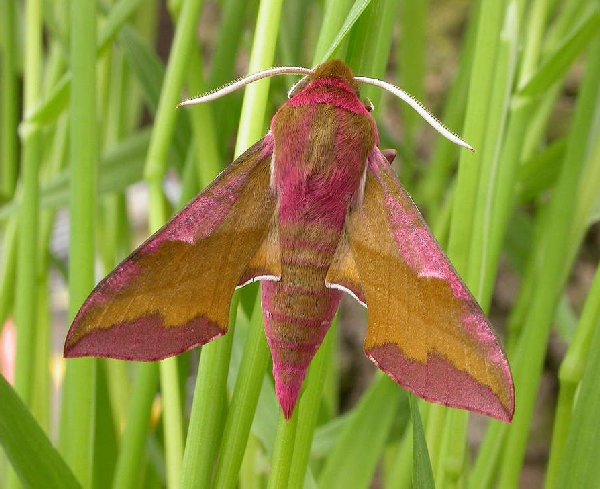 |
|
Small
Elephant Hawk-moth © Neil Sherman
|
Three species have
been notable by their numbers in the trap. The Cinnabar has been abundant
by day and night. 29 were in the trap on the 7th, but this total was beaten
and then some on the 26th when there were 120! This coincided with a moth
event at Maidscross Hill, Lakenheath where at least 700 were seen! Must
have been lots of Ragwort around last year! Also in large numbers that
same night was the Orange Footman, with 29 trapped. This species has been
common all month with another good total of 19 appearing on the 29th –
it is still being recorded at the time of writing in early June. The last
species, the Brindled White Spot, has not been as abundant but has still
been in better than normal numbers with 5 or more being trapped most times.
Micros have begun
to increase in the trap, with the following of possible note here. Cryptoblabes
bistriga was trapped on the 26th, the first for the year. Eulia
ministrana, one of my favourite tortrix moths, has also been noted.
The migrant Plutella xylostella was seen on the 5th.
Notable daytime observations
included a female Broad-bordered Bee Hawk-moth, seen on the 29th egg laying
on Honeysuckle. Also seen abundantly was Micropterix calthella on
Buttercup flowers, and, on Cuckoo-flower, Adela rufimitrella (but
not in such large numbers). Beating for larvae on the 10th produced a few
nice caterpillars, with singles of December Moth (found on Hazel), Northern
Winter Moth (from Birch) and Satellite (from Oak). Also beaten was an adult
Caloptilia
syringella.
For the third year
running, Emperor Moth larvae have been found feeding on the Clubhouse roses
– this seems to be an easier place to see them than when they are on heather
and well camouflaged!
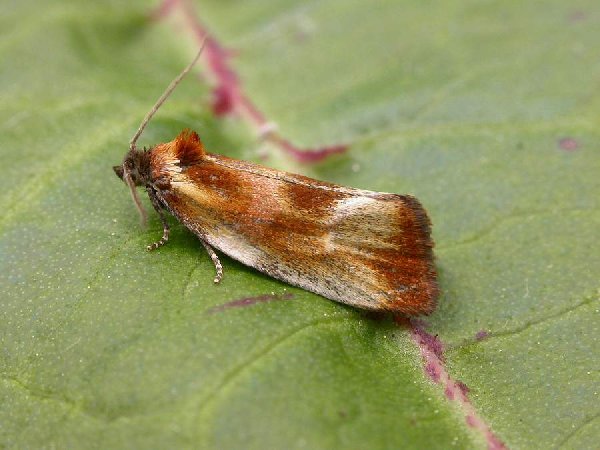 |
|
 |
|
Eulia
ministrana
© Neil Sherman
|
|
December
Moth larva © Neil Sherman
|
June 2003
Warm weather dominated
the month, with some more excellent nights trapping. After a slow start,
this year seems to be getting better as the season progresses! The only
gap in moth recording at the golf course was in the third week, when I
was away on holiday mothing in France (more on this in a later article!).
Two MV lights were
run on 9 nights, with an 11w Actinic trap put out as well on a few occasions,
this producing a total list of 246 species. Best nights were the 18th with
102 species and the 29th with 99 species.
Macros of possible
interest included: Grass Emerald (the first of the year appeared on the
29th), Satin Wave (on 2 dates), Spinach (on the 11th a nice fresh example
– not seen that regularly at this site), Shaded Pug (2 records with the
first one coming to the 11w actinic trap), Broom-tip (on the 5th), Lilac
Beauty (on the 19th trapping near its foodplant, honeysuckle – this species
is now recorded annually whereas in the past it was rarely seen), Brindled
White-spot (in good numbers), Lobster (the third site record on the 18th),
Orange Footman (still appearing in good numbers with a maximum of 15 mid
month), Gold Swift (one on the 5th), Lunar Yellow Underwing (3 singletons
during the month), Purple Clay (on 2 dates – another species now seen annually
here but not very often a few years ago), Grey Arches (18th), Cream-bordered
Green Pea (on the 1st) and the first Shaded Fan-foots (or should that be
feet?) of the year (4 on the 18th).
Micros of possible
note here were: Nemapogon cloacella (on 3 dates with most appearing
inside my polytunnel for growing Heather!), Tinea trinotella (3rd),
Argyresthia
cupressella (on the 18th a long way from any foodplant!),
Cochylis
nana (a new site record – recorded 5 times during the month), Tortrix
viridana (reaching a peak this year on the 15th when 250 were trapped!),
Sitochroa
verticalis (one on the 29th – now recorded annually here) and Nascia
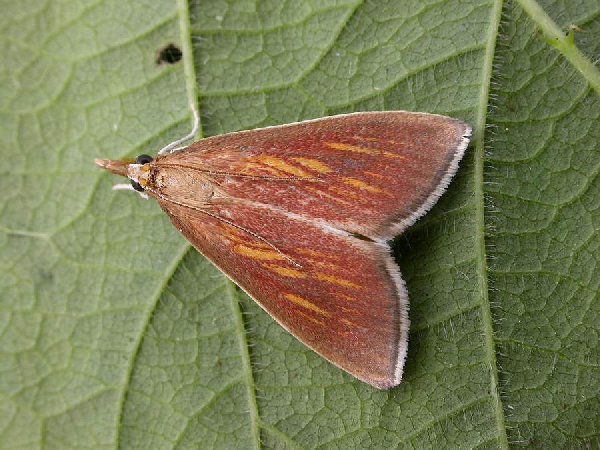
cilialis (on the 11th - a new site record of this increasing
moth).
 |
|
Nascia
cilialis © Neil Sherman
|
Day sightings included
Mother shiptons, seen flying over heather areas when it was sunny, with
a peak of 5 on the 4th. Also seen throughout the month were plenty of Silver
Y, but, as usual it seems with this species, not many appeared at light.
Emperor Moth larvae (on Heather) and Broad-bordered Bee Hawk-moth larvae
(on honeysuckle) were also found.
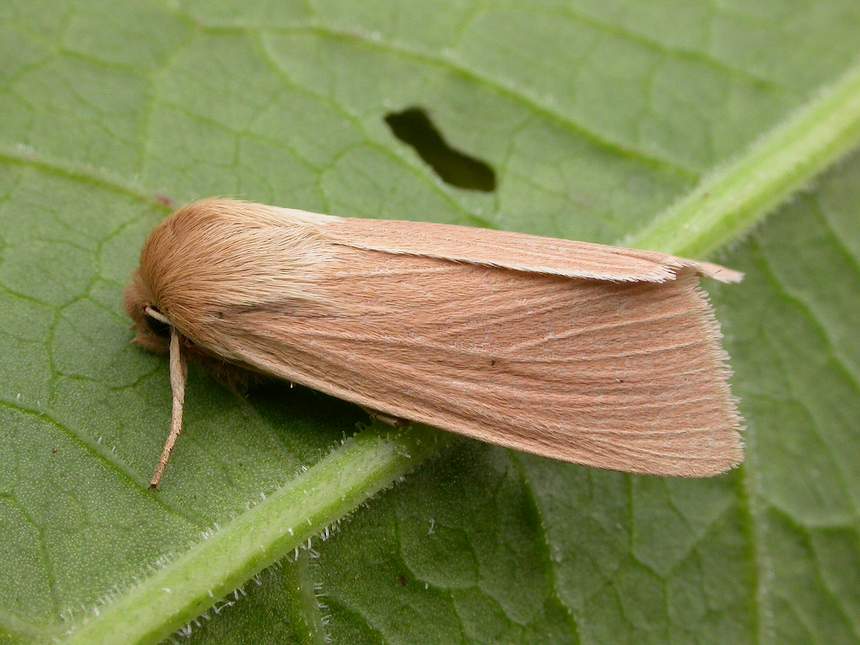
The moth that caused
the most controversy this month was a wainscot that appeared on the 9th.
On appearance my suspicion was that it was a Mathew’s, as it didn’t seem
to have the really pronounced veins of the Common wainscot, and was an
orange colour. Upon showing it to members of the group, initial verdicts
of ‘Common’ were received but subsequent comparison with reference specimens
showed similarities. I was (and still am) convinced it was Mathew’s, and,
after seeing that the hindwings were dark rather than white this added
to my claim.
 |
|
 |
|
Cream-bordered
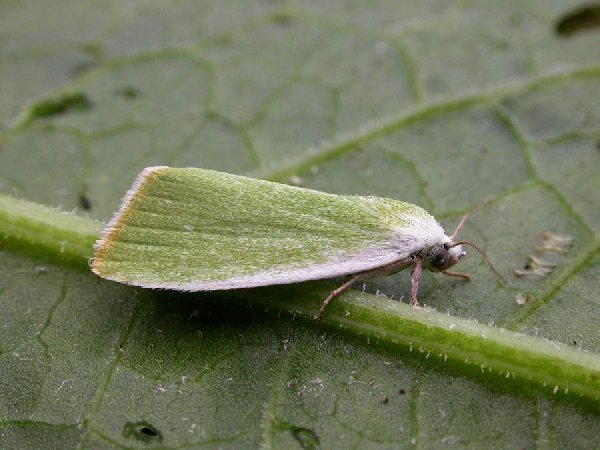
Green Pea © Neil Sherman
|
|
Mathew's
Wainscot? © Neil Sherman
|
News
from the Thurston recorder – a postscript - Paul Bryant
I was slightly ashamed
to discover that it has been almost exactly a year since I last put finger
to keyboard as the Thurston recorder. A lot has happened since then and
as most of you will know Ann and I decided to sell or house in the hope
of finding something bigger and better. Finding a buyer was no problem
and we duly moved out of Howes Avenue at the end of March this year. However,
finding the something bigger and better has proved more of a challenge
so we are currently residing, courtesy of Ann’s parents, in Hopton. That
hasn’t stopped me trapping of course but more of that hopefully in the
next newsletter.
So, did I reach the
300 barrier you ask? Well, despite the somewhat indifferent weather at
the start of the month there were plenty of opportunities to trap and July
was a very productive month with several nights reaching the 50+ species
barrier. Thirteen new species were picked out amongst the, now, more regular
garden visitors – Coleophora palliatella, Blastodacna hellerella,
Lozotaeniodes
formosanus, The Phoenix and Short-cloaked Moth all on the 6th, Pempelia
formosa on the 11th, Eucosma hohenwartiana on the 13th, Epermenia
chaerophyllella on the 16th, Small Rivulet & Lesser Common Rustic
on the 18th, Phyllonorycter trifasciella and Batia lunaris
on the 25th and finally, a Rosy Rustic on the 29th. I also trapped what
I provisionally identified as a Marbled Green on latter date but this is
still subject to discussion and now awaits anatomical study to confirm
its true identity!
 |
|
 |
|
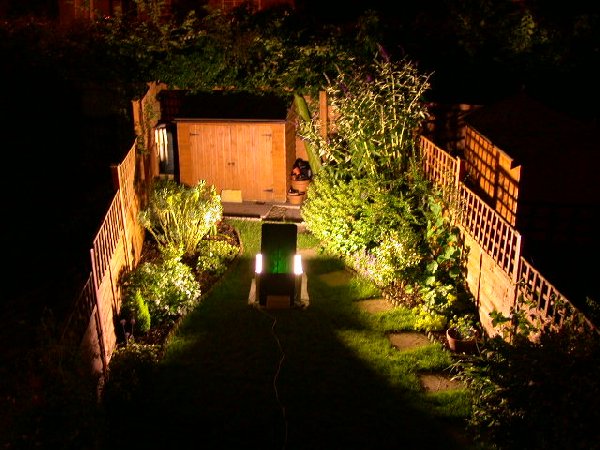
Paul's
Thurston garden trap © Paul Bryant
|
|
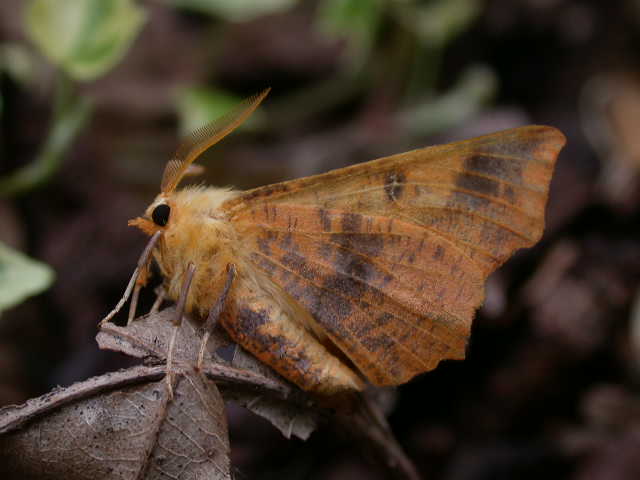
Phoenix
© Paul Bryant
|
August was a quiet
by comparison with the actual number of species down on July and with no
new additions. I did record (or is it suffered) 60+ Large Yellow Underwings’
to actinic on the 27th but, by way of compensation, also recorded a single
Vapourer on the same night.
Things picked up
again in September with Eudonia angustea, Large Thorn and Brindled
Green on the 12th getting the month of to a god start as they were all
new. Subject to a final count back it looks like Large Thorn may win the
prize as species number 300! The following day I recorded the first of
what turned out to be a small trickle of Lunar Underwing’s, as by the end
of October I had notched up fifteen in total. Other new arrivals were Orange
Sallow on the 15th, Oak Nycteoline on the 19th and Sallow on the 20th.
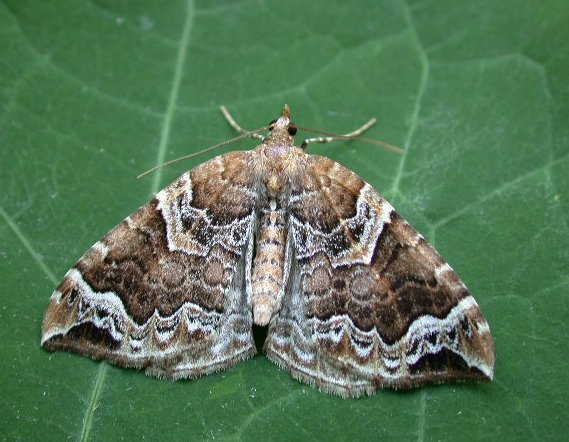
 |
|
Large
Thorn © Paul Bryant
|
October and November
were quite again, for a number of reasons, but Udea ferrugalis and
Brick were added to the list and single Merveille du Jour and Feathered
Thorn were a nice way to round of the season. A single Winter Moth attracted
to our porch light gets the prize for being the last moth of the year (on
the 22nd December).
With the house going
on the market at the start of 2003 and trying to fid a suitable weather
window to make the effort worthwhile, very little trap only went out on
three nights with the expected Small & Common Quaker, Hebrew Character
and Early Grey being recorded in small numbers. Not to be outdone, 2003
did turn up the first Twin-spot Quaker for the garden taking the garden
list to approx. 306 species. The highlight however was an e-mail from Jon
Clifton to confirm that one of many species he kindly helped identify from
last year was Phyllonorycter kuhlweiniella (= saportella),
an oak species previously reported from the Brandon and Thetford area according
to Tony and from the South Lopham area according to Vol. 2 of MGBGI.
Finally, may I say
a big thank you to everyone who helped get the list up to the stage it
was by helping me identify all those many and varied species that I struggled
with due to a lack of knowledge or literature.
Dunwich
Heath NT, April to June 2003 - Mark Cornish
In April the most numerous
species were typically: Clouded Drab, Hebrew Character, Brindled Beauty,
Yellow-horned, Red Chestnut, Common and Small Quaker. Northern Drab was
also recorded for the first time along with a few Lead-coloured Drab and
Oak Beauty.
May saw the Narrow-winged
Pug (Peak of 91 trapped, 31/05), Shuttle-shaped Dart, Heart & Dart,
True-lovers Knot and Treble Lines form the bulk of the numbers. Emperor
Moth had a poor year with only two trapped. Powdered Quaker was frequent
(unlike 2002 when it was very scarce) along with Early Grey and Light Brocade.
A very fresh Oblique Carpet was probably the most notable (with two also
caught in 2002) along with several White Colon and Yellow Belle. Pempelia
palumbella was daily and several Grey Birch were trapped after none
in 2002. Otherwise there was the typical mix of the usual suspects.
June was more productive.
Notable pyralids were Nascia cilialis, Synaphe punctalis
(with 27 trapped 30th), Schoenobius gigantella, Phycitodes binaevella
and
Pempelia
formosa (trapped along elm hedgerow). Freyer’s (1), Maple (2) &
Triple-spotted Pug (1), Tawny-barred Angle (3), Treble Brown Spot (5) and
Grey Arches (7) were new from 2002. The typical red form of Barred Red
was seen for the first time after two of the green form in 2002, whilst
Heart & Club was recorded for only the 2nd & 3rd time in two years.
Shore Wainscot (1), Star-wort (1), Kent Black Arches (5), Grass Emerald
(3), Silky Wainscot (6), Water Ermine (2), Maple Prominent (1) and Flame
Wainscot (3) were notable and caught for the second year running.
Though Rosy Wave was an exceptionally good record on 22nd and 5 Shaded
Fan-foots were trapped along with a Royal Mantle at Mount Pleasant on 28th.
Most numerous were: Large Yellow Underwing (peak 82 trapped, 22/06), Dark
Arches (peak of 78 trapped, 22/06), True Lover’s Knot (peak 70 trapped,
29/06), Flame (peak of 31 trapped, 22/06), Heart & Dart (peak of 32
trapped, 01/06), Buff Ermine (peak of 12 trapped, 17/06), Brown Rustic,
Narrow-winged Pug and Brown-silver line (Peak of 40+ trapped, 15/06). Whilst
trapping at the northern end produced 30+ Mottled Beauty (20/06). Pebble
Hook-tip (only 4 trapped in May and 5 in June) and Lesser Swallow Prominent
(only 3 trapped in may & June) are having a poor year compared to 2002,
although Clouded Silver and Cream-spot Tiger (with 34 trapped in June,
peak of 8, 10/06) very good. Mullein Wave, Light Brocade, Rustic Shoulder-knot,
and Vine’s Rustic seem to be more numerous than 2002. Broad-bordered Bee
Hawk-moth was seen late in the month and migrants were represented by Rush
Veneer (Nomophila noctuella), Diamond-backed Moth (Plutella xylostella),
Hummingbird Hawk-moth, several dark Sword-grass and good numbers of Silver
Y.
Contact
details
Please send any Suffolk
moth records, moth articles or other queries to myself (preferably via
email) at :
3 Powling Road, Ipswich,
Suffolk IP3 9JR
Email : tony.prichard@btinternet.com
(also tony.aw.prichard@bt.com
)
Suffolk Moths
web site (home of the SMG): http://www.btinternet.com/~tony.prichard
SMG Email Discussion
Group:
http://groups.yahoo.com/group/suffolkmothgroup
Essex County Moth
Recorder : Brian Goodey, 298 Ipswich Road, Colchester, Essex. CO4 0ET.
E-mail: essexmoths@dial.pipex.com
The
Newsletter
This is the newsletter
for the Suffolk Moth Group. It is distributed free to those with email
and at a £2 per annum subscription for paper copies. Four issues
are produced per year, usually in March, June, August and November. I am
always on the look out for articles that will be of interest to moth recorders
in Suffolk, although field and site reports should be topical. Articles
should arrive by the end of the month preceding the month in which a newsletter
is produced, eg. the deadline for articles for the March newsletter is
the end of February.
Adverts
|
|
|
ANGLIAN LEPIDOPTERIST
SUPPLIES
ALS
www.angleps.btinternet.co.uk
Specialising in various moth trap designs
and related equipment.
|
|
|
-
Pheromone lures for the 2003 season
-
Light weight batteries for portable equipment
-
Electrical kits from £37.00
-
Full range of MV bulbs
-
Full range of Butterfly/moth Nets
-
Specimen pots for micros to Hawkmoths
-
Honda EU10 Generators, contact us for offers
-
Range of microscopes and dissecting equipment
-
Store Boxes and pin-boards
|
|
|
Visit us at our web site for full details
or send a SAE to
ALS, Station Road, Hindolveston, Norfolk,
NR20 5DE.
For friendly advise phone us on 01263 862068/01606
783371 or e-mail jon.clifton@btinternet.com
Proprietors: J Clifton & A Wander
|
 |
ALS are proud to be working with Butterfly Conservation.
For details visit www.butterfly-conservation.org or write to BC, Manor
Yard, East Lulworth, Dorest, BH20 5QP |